Saturday, August 13, 2005

I'm All Alone...


I'm all alone, there's no one here beside me,
My troubles are all gone, there's no one here to deride me..."

I've been getting over 200 hits a day lately, but few comments outside of a small group of great people. So I just thought I would mention that I do like comments and try to respond to each and every one of them. Really, it's okay, I don't bite!


I also just noticed that I have received over 20,000 visitors since I started this site (which is a heck of a lot more than what I thought I'd have so (imagine this next bit in your best Eyore voice):

Thanks for noticing, I'm just grateful for the attention, don't leave any comments if you don't feel like it, I'm just happy to have you visit. I don't really need comments...

Have I whined enough yet?

Read more!

Life is Sooo Unfair

Do to some recent feedback on my Naked Mole Rat posts I thought there might be a way of making some money off of it - maybe millions - so I could retire in style. My first thought was I could create a Naked Mole Rat stuffed animal or maybe a beanie baby (could you imagine the reaction of some kid pulling one of these ugly spuds out of a toy meal?). But then I found this:


from here

Oh well, back to the drawing board.

Read more!

Ancient Ozone Holes and Mass Extinctions

This blog is, primarily, about evolution. Whenever possible I like to publish stories about some of the interesting techniques scientists use to learn things about the past. This is another along those lines.

Lycopodium magellanicum is a species of clubmoss native to South America, and islands in the southern Atlantic and Indian oceans.


The leaves are arranged in cones which bear sporangia containing spores of one type only.


Reserchers examined the spores of Lycopodium magellanicum for UV-B screening pigments. The idea being that as the ozone layer thins an increase in UV-B screening pigments should be observed. This is exactly what they found. Basically this first step was a test to see if the methodology (examining spores for UV-B screening pigments) would yeild results relevant to the question of whether or not we can detect ozone depletion in the past. Having answered the question in the affirmative, the researchers are turning their attention to the Permian-Triassic boundry some 250 million years ago (I should mention that the chemical traces of UV-B screening pigments can be detected in the geological record).
One of the important events, geologically speaking, to occur around the end of the Permian was the volcanic eruption of the Siberian traps, a byproduct of which is the destruction of the ozone layer. Hypothetically, this would mean we should detect an increase in UV-B screening pigments in spores from that time period.

For more info:

INVITED: THE SIBERIAN TRAPS, STRATOSPHERIC OZONE, UV-B FLUX AND MUTAGENESIS

New Window Into Ancient Ozone Holes

Permian Extinction

Rocks Reveal Details of Mass Extinction

Read more!

Friday, August 12, 2005

Naked Mole Rat Porn: or This Means War

One of the blogs I visit on a regular basis is Dharma Bums There, the stories are always interesting, the writing is always great and the pictures would make Ansel Adams weep in jealousy. Today, I visit their site and what do I discover but Squirrel Porn! I was very shocked...that I didn't think of it first. So without further ado I am proud to present: NAKED MOLE RAT PORN!


I'd really like to see someone top that!

Read more!

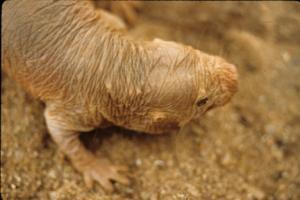
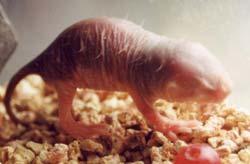
Friday Naked Mole Rat Blogging


Naked mole rats have a pretty distinctive social structure - which in some ways is similar to that found in social insects.

From Science Daily:

They live in Somalia, Ethiopia and Kenya. They are 3-6 inches long, have pink furless skin, tiny eyes which never see the light of day, and long front teeth for digging. Despite their tiny size, the naked mole-rat family den may stretch for 2 miles entirely underground, with various rooms. In one room, a plant root protrudes to provide a meal; in another is the "potty." When a new hallway is needed, usually for new food supplies, the naked mole-rat siblings form an earth moving chain to pass dirt out a hole which later is covered to block out intruders.

The most unusual room is the largest. It's where Momma naked mole-rat produces more babies – as many as 12 at a time every couple of months. Here she is stoked by her numerous mates and tended to by any number of offspring whose lot in life - if not to dig tunnels - is to keep Momma happy.


Apparently, this is a really good case of altuistic social behavior in mammals, where some mole rats give up reproduction and help related mole rats care for the young. Researchers are currently investigating the relationship between DNA and social structure:

Ingram looked at regions of DNA - specifically the microsatellites, which represent distinct DNA bands, much like a satellite, which separate from the main DNA band. These rapidly changing regions of DNA don't code for any particular trait, as far as scientists can tell. Ingram thought these regions shouldn't be overlooked.

"If there is a random-mating population, there are a lot of sizes of those DNA bands, but a child only gets one set from the mother and one from the father," Ingram noted. These markers are used in paternity cases for humans, she said.

She looked for changes in the processes and patterns of this strand in mole-rats, she said.

"The current methods of analyses of microsatellite markers are oversimplified and may lead to incorrect conclusions when looking at natural populations and their social structures," Ingram said. "The relationship among members of the mole-rat family are well-accepted. Some species (of mole-rat) are strictly solitary while others, such as the naked mole-rat, are highly social."

DNA markers, like the satellites, are important because they can reveal how traits pass from one mother to her multitude of babies conceived by various interrelated fathers. That may help understand why scores of offspring in the family are willing to support the mother naked mole-rat.

Read more!

Thursday, August 11, 2005

4,000 Year Old Archaeological Site In Danger


The above is a picture of a squirrel pipe found at the Davis site in Eureka, MO (a town not all that far from St. Louis). The site dates to the Archaic and also has Woodland and Mississippian occupations as well.


The above is a picture of a cookpot of the Mississippi Plain variety.

The problem is threefold. First, the site has not been carefully explored - only a preliminary survey was carried out. Second, developers want the land to build a subdivision:

Owned now by Buccaneer Properties, the knoll was included in a recent development proposal before the St. Louis County Council for a zoning change to build 80 homes on 55 acres on Eureka Road, just east of Eureka.

That proposal got bad reviews from the county planning and zoning commission. But the fate of the knoll, where two civilizations appear to be on a collision course, still is in limbo.


Third, Missouri law regardin archaeological sites:

"Missouri has no laws requiring investigation of important artifact sites before they are built over, and only the flimsiest requirements for notification to authorities if a developer uncovers bodies..."

A complete excavation of the Davis site could add critical missing pieces to the puzzle. Harl said that would cost between $50,000 and $100,000.

Illinois law requires the developers of such a site to bear this cost, but Missouri has no such obligation, although a seller of the property could make the sale contingent upon the developer paying for the dig.


A preliminary study was done of the site several years back:

Jack Davis took his squirrel pipe and other pieces to be examined by archaeologists from the Missouri Archaeological Society in 1987. Two society members, professors Michael and Neathery Fuller of St. Louis Community College, returned to the Davis home, documented the collection and later set up a Web site to display the squirrel pipe, at Davis Site.

That site exploration was a preliminary survey, not a major field effort.

Read more!

Tuesday, August 09, 2005

Cindy Sheehan

A lot of bloggers have written about this sory so it should be pretty familiar to everyone. A woman loses her son in Iraq and wishes to question the president - her president - about it. The President hides at his ranch and threatens to have her arrested in the name of national security.

So, a greiving mother stands on the side of the road waiting for an answer that will never come while the President - her President - sits in his ranch surrounded by all the panoply of power and avoids a question - and really it's such a simple question - that every mother has the right to ask and every mother should demand the answer. Yet the President - her President avoids the question. Perhaps the question strips all the false pretenses and vanities that our President has built up about himself. Perhaps the answer would reveal something in the soul of our President that he dare not face. Perhaps answering the question would be like looking in the mirror and seeing Richard the Third staring back at him.
Perhaps his reflection would say:
"Perjury, perjury, in the high'st degree,
Murder,stern murder, in the dir'st degree -
all several sins, all used in each degress,
Throng to the bar, crying all 'Guilty, guilty!'
I shall despair. There is no creature loves me,
And if I die, no soul shall pity me."

It seems strange to see a woman standing in the road asking for so little while the leader of the most powerful nation on earth sits behind fences, sits behind the Secret Service, sits behind the pretense of national security. Some moral clarity is lacking here that perhaps an answer might reveal. I think it is shame that prevents the President from going out in the street and answering this woman, I think if he were to come face to face with her the facade would crumble - being stripped of all the illusions you hold about yourself can be painful.
So, I say Mr. President you are no gentleman, you are no christian, you are no leader until you can face the grief of a mother crying - and perhaps dying a little - for her son.

Read more!

New Species of Lemur Discovered


Ain't it cute? It's called Microcebus lehilahytsara and was discovered in Madagascar (where else).

You can find more info here

Added Later: Thoughts from Kansas has a more indepth post on the lemur - as well as pictures of the second new lemur. Check it out.

Added Even Later: One of the more interesting things about Josh's post is the few tidbits of info we learn about Steve Goodman. We need more of this kind of thing. Not because we should all be name droppers but because it puts a human face on science and makes it harder for those who oppose science. If one knows about someone like Steve Goodman who "...basically lives in the field, coming back to the Field Museum now and then to drop off specimens..." it becomes harder to believe scientists are engaged in some shadowy conspiracy to silence critics and enforce ideological conformity, etc.

Read more!

Forensic Science

This is interesting - and scary! Apparently, Forensic science isn't quite as scientific as we all thought:

"The underlying principles of the identification forensic sciences have never been rigorously scientifically proven," said Jay Siegel, director of the undergraduate forensic science program at Indiana-Purdue University in Indianapolis.

"This includes handwriting, fingerprints, and firearms, and tool marks," he said.

According to a new study, traditional forensic analysis often relies on untested assumptions and semi-informed guesswork. It can also sometimes produce the wrong results.

Drawing on data from 86 DNA exoneration cases, the researchers found that forensic science testing errors and false or misleading testimony by forensic scientists had been leading causes in the false convictions.


In other words, folks are being convicted based on the prestige value of having "scientific" evidence?

One of the researchers, Jonathan Koehler, says it's time for forensic sciences to adopt the culture of other sciences.
"This includes being more conservative, requiring empirical support for claims, adopting higher professional standards, and generally conceding the important role that the possibility of error plays in interpreting results," said Koehler, a professor of behavioral decision-making at the University of Texas in Austin.

Wonder what the intelligent design community will make of that since ID frequently claims Forensic Science as an ally?

Error rates range from 20% (fingerprint analysis) to above 60% (bite marks, voice identification):

During the past decade, scores of people who were convicted of serious crimes have been exonerated by DNA analyses of crime-scene evidence that had not been tested at the time of their trials.

Drawing on data from 86 such cases, Koehler and his colleague, Michael Saks, a law professor at Arizona State University in Tempe, found that forensic science testing errors played a part in 63 percent of the wrongful convictions. Only eyewitness error was a more common factor.

The study also found that forensic scientists are the witnesses most likely to present misleading or fraudulent testimony. In 27 percent of the cases reviewed, expert witnesses were found to have given false testimony.


Part of the problem concerns a concept called discernable uniqueness which states that if two marks appear indistinguishable, they must have been produced by the same object:

"Forensic scientists will likely say that they know it, because they've never found different objects that have identical markings across many years of forensic science. At first blush, this might seem like an impressive boast. But consider this: Suppose that exactly a hundred pairs of firearms out of the estimated 100,000 guns in a Texas town do, in fact, share indistinguishable rifling markings."

"If each of a hundred firearms experts examined ten pairs of guns from the town's gun population every day for ten years, there is about a 93 percent chance that none of the indistinguishable pairs will have come under examination. That is, despite a thousand 'collective years' of forensic science experience—and more than three million gun-pair examinations—the failure to find even a single pair of guns with indistinguishable markings would offer little basis for drawing conclusions about whether bullet markings on guns in this town are indeed unique."


So, if I understand this correctly you would get a lot of false positives - which have to due with sampling procedure.

It goes without saying that this has profound implications for how expert testimony is used by the criminal justice system (and I may do a post on how this impacts fornesic anthropology) - but that is not the point of this post. The point is that those aspects of forensic science which ID proponents argue give the most support to ID are being abandoned by forensic science. They are being replaced by a more rigorous scientific procedure that gives no support to ID.

Read more!

Monday, August 08, 2005

Bilateral Symmetry and the Cambrian Explosion

This is cool.

Bilateral symmetry is a character of most organisms (except sponges, jellyfish, ctenophores and echinoderms). According to my book on vertebrate structure (An Analysis of Vertebrate Structure, 2nd ed, by Milton Hildebrand) this is a fundamental characteristic of vertebrates. A 2004 discovery has pushed the origins of bilateral symmetry back to approximately 600 million years ago - to the Precambrian.

From the article:

The discovery is crucial. It suggests that the earliest ancestors to modern-day animals developed before the Cambrian explosion. That so-called explosion period, 488 to 542 million years ago, envelops the time on Earth when most animal groups first appeared.

In his article, Bottjer suggests that the famous Cambrian explosion was more accurately "the exploitation of newly present conditions by animals that had already evolved the genetic tools to take advantage of these novel habitats."

Rather than solely genetics, it may have been the critters' ability to grow large that led to the explosion. The growth spurt, Bottjer said, may have been caused by a drastic rise in dissolved oxygen in seawater. More oxygen for breathing reduces size constraints.
(emphasis mine - afarensis)

Even more interesting is the process underlying the discovery:

But it took incredible patience and work to uncover the fossils, which measure about 200 micrometers across. The team sliced the samples into thousands of see-through-thin layers and examined them under a microscope. Finally, among the 10,000 slides, the collaborators discovered 10 examples of the fossil type they had been seeking. After more months of painstaking analysis, the group confirmed the examples were fossils of miniscule bilaterian animals.


So after plenty of hard work a phenomenal new discovery was made - one that throws some light on Precambrian life and the Cambrian explosion. Another talking point knocked out from beneath ID proponnents.

Teach the Controversy says I.

Note: those of you with a digital subscription to Sciantific American can go here for more info

Read more!

More This and That: Dembski and Human Evolution

Why is it when you do a Google search on Ape Human DNA you get a bunch of creationist sites?

While searching for the above I stumbled across Reflections on Human Origins by Dembski. Haven't had time to read it yet but apparently we get Dembski's notions on human evolution - should be hysterical. Soon as I print and read it I'll do a post on it.

Read more!

Globalization and Diet

Malnutrition And Obesity Increasingly Co-exist In Global Community

The part of the impact of globalization is an increase in diabetes and hypertension:

"A global nutrition transition has and is occurring on a continuum. While problems of under-consumption and poor nutritional status continue to exist, increasingly problems of diet/chronic diseases are emerging as significant public health issues globally," says Kennedy. A demographic shift has resulted in increased life expectancy in many countries, and in some countries, this means an older population. Closely tied with this change in age structure is an epidemiological shift which has decreased communicable diseases and increased chronic diseases, such as diabetes and hypertension, she reports.

"An increase in availability of more high-fat and sugar-laden foods has led to a surge of nutrition-related chronic diseases around the world. At the same time that diets have changed, physical activity has decreased. The highest rates of overweight and obesity are now often found in low-income groups. Many populations have been left in the midst of an obesity crisis that exists with food insecurity and under-nutrition," Kennedy summarizes. "Chronic diseases can no longer be labeled as 'diseases of affluence.' Unfortunately, the message that the global nutrition profile is changing hasn't reached policy makers, and they need to be aware that it is occurring."


This happens whenever people change to a western style diet (the New World Syndrome is a good example).

In a separate article published in the May 2005 American Journal of Clinical Nutrition, Kennedy and co-author Linda Meyers, PhD, Director of the Food and Nutrition Board, Institute of Medicine, note that large parts of the developing world are plagued with micronutrient deficiencies. "Deficiencies of micronutrients, such as iron, iodine, zinc and vitamin A, contribute to 'hidden hunger' and while the statistics on micronutrient status for women in developing countries are scarce," she says, "it is clear that a large percentage of women from developing countries suffer negative health and nutrition consequences."

Read more!

Sunday, August 07, 2005

WHich Harry Potter Character Are You?

Pirate Monkey's Harry Potter Personality Quiz
Harry Potter Personality Quiz
by Pirate Monkeys Inc.

Explanation of the Results:
This type of personality test uses four indexes of personality and the combination of the four is your personality type. The first index relates to how you interact with other people and can be Extroverted (E), meaning you're more outgoing or Introverted (I), meaning you keep more to yourself. The second relates to how you make decisions; whether you're Intuitive (N), getting answers from within, or you rely on Sensing (S) information from your surroundings, using your five senses. The third relates to whether you're more emotional and Feeling (F) or rational and Thinking (T). The fourth relates to whether you prefer things to be organized, meaning you're Judging (J), or you prefer things to be more unbound, meaning you're Perceiving (P).

WOOORD!
I can live that!

Note: This is actually your standard Myers-Briggs personality test with a Harry Potter theme added. I've taken these before and the results (for me) are pretty consistent (They are always INTJ).

Read more!

Bipedal Locomotion and Semicircular Canals

I am currently working on a post for Transitions involving the molecular evidence for the common ancestry of apes and humans (Note: this is slow going because I am having trouble finding websites with age appropriate discussions of this material - if you know of any let me know as I hate doing posts without giving links for people to get further information). While searching the internet I kept stumbling across a lot of creationists sites disputing this relationship. An incidental finding was an argument concerning bipedality in Australopithicines based on CAT scans of the inner ear morphology. Which is what this post is about.

An example of the creationist argument:

High-resolution computed tomography, known as CT or Cat Scan, was used to scan the inner ear labyrinth of 53 humans, a few dozen apes consisting of pygmy chimps, chimps, gorillas, orangutans, and other species. They also scanned fossil humans (early Homo and H. erectus), Australopithecus and Paranthropus. Reporting in Nature, Wood and his coworkers made height and width measurements of the arc of each semicircular canal from the CT scans. From these measurements, they calculated the radius of the arc's curvature. Among the living specimens, they correlated the arc size of the three semicircular canals with the body mass. Taking body mass into account, modern humans have larger anterior and posterior canals and a smaller lateral canal than the great apes. According to Wood, Homo erectus is the earliest fossil hominid to demonstrate the modern human morphology of the inner ear. The dimensions of Australopithecus and Paranthropus inner ears resemble those of living great apes. Wood says,

"Modern human locomotor behaviour [walking] makes particular demands on the vestibular apparatus for it involves the maintenance of an upright body posture by balancing on very small areas of support."

In other words, humans have the correct inner ear configuration for obligatory upright walking, while apes, australopithecines, and Paranthropus do not.

Finally, Wood concludes his report by saying,

"This study demonstrates that the morphology of the bony labyrinth has the potential to provide information about both the locomotor behaviour and the phylogenetic relationships of early hominids." [Wood, 1994]


Another example:

Some interesting new work has also helped to demolish the idea that the australopithecines habitually walked upright. Computerized X-ray scans are able to reveal the bony structure of the inner ear. The shape of this has been shown to directly reflect patterns of movement. Understandably, humans (the only creatures alive that walk habitually upright) have an inner ear structure which stands out from the rest. When this analysis is carried out on fossil skulls, the results are completely in line with modern creationist expectations. So-called Homo erectus (which even some evolutionists are saying should be reclassified as Homo sapiens) has an inner ear structure just like ours; whereas that of all australopithecines (and habilines) studied are 'decidedly ape-like'.


There is also this Intelligent Design version:

Other recent studies have found that the handbones of Lucy are similar to those of a knucklewalking ape, and that their inner ear canals, responsible for balance and related to locomotion, resemble small inner-ear canals of the great apes rather than larger canals found in humans and other members of the genus Homo.
(Note: I may do something on this article as it purports to lay out an ID theory of human evolution.)

So what does it all mean? Let's start with some basic anatomy. The picture below is a cross section of the inner ear.


The anterior and posterior semicircular canals are labeled "B" (the horizontal canal is not labeled). Note that both of these travel through the bone. Below is a picture showing the semicircular canals in relation to blood vessals and nerves, note also the two organs called utricle and saccule.

The function of this complex is to help maintain balance. The Utricle and saccule respond to linear acceleration (turning your head left or right, for example)and the orientation of the head relative to gravity (tilting your head left or right for example). The horizontal semicircular canal also has a role in the vstibulo-ocular reflex - which allows you to keep you gaze fixed on an object while your head is moving (trying to read a sign in a moving car for example). The semicircular canals respond to angular accelerations.

In humans the horizontal semicircular canal and utricle are at an angle to the naso-occipital plane.


When a person walks or runs they tilt their head forward causing the plane of the horizontal semicircular canal and utricle to be parallel to the earth horizontal and perpendicular to gravity. The anterior and posterior semicircular canals are positioned verticall in the skull and at angles to each other.


Note that the anterior on one side is oriented in the same fashion as the posterior on the other side.

Back to the creationists. Two studies are usually cited by creationists in order to claim that Australopithecines were apes. The first is by Spoor. The second is by Spoor et al and is available here. Spoor et al used CT scans to examine the morphology of the inner ear of 31 extent primates and 12 fossil hominids. They used height and width measurements to compute the radius of curvature of the arc. One of the findings of the study was that arc size of each of the three semicircular canals scaled with body mass. When body size is taken into consideration, humans have larger anterior and posterior and smaller horizontal semicircular canals than apes. They also discovered that the naso-occipital and sagittal orientation of the semi circular canals was the same in apes, humans and fossil hominids (this is not surprising since inner vestibular anatomy is a highly conservative trait in evolution). Spoor et al state that this implies that the ape condition was the likely ancestral condition and that the functional consequences of the elarging semicircular canal arc are not fully understood. They also point out that:

"...if the enlargment of the anterior and posterior canals is functionally related to modern human-like obligatory bipedalis, then at least in this respect the vestibular apparatus of the australopithicines was not adapted to this type of locomotor behavior(Spoor et al 1994, Nature 369:645-648)"

Basically then, what Spoor et al concludes is that australopithicine semicircular canals were somewhat different (in size but not orientation) from humans but they aren't sure what the functional meaning of the differences are. Which isn't quite what the creationists were arguing. One other note, Australopithecus afarensis was not included in the study.

For more on semicircular canals go here

Read more!

Organic Molecules in the Early Universe


Nasa's infrared telescope (the Spitzer Telescope) has found traces of organic molocules that are believed to be about 10 billion years old:

Using Spitzer, scientists have detected organic molecules in galaxies when our universe was one-fourth of its current age of about 14 billion years. These large molecules, known as polycyclic aromatic hydrocarbons, are comprised of carbon and hydrogen. The molecules are considered to be among the building blocks of life.

These complex molecules are very common on Earth. They form any time carbon-based materials are not burned completely. They can be found in sooty exhaust from cars and airplanes, and in charcoal broiled hamburgers and burnt toast.

The molecules, pervasive in galaxies like our own Milky Way, play a significant role in star and planet formation. Spitzer is the first telescope to see these molecules so far back in time.


The interesting part about this, to me, is that these molecules play a role in star and planet formation. Not being an astronomer I can only wonder at how many other organic molecules play a role in these processes.

You can also go here for more info.

Read more!

Saturday, August 06, 2005

Teaching the Controversy? (ID Blogwhoring)

The ID movement is placing a premium on teaching the controversy. On the other hand they have been roundly criticized for not allowing comments on their blogs. What just dawned on me (I'm a bit slow on the uptake, being a hominid of very little brain - 380 to 450 glorious centimeters), however, is that they don't link to science websites or blogs. Which is odd. I have several links to ID or creationist websites and blogs - granted, they are under a snarky header, but a link is a link. So how 'bout it all you ID and creationist believers? Link to me and truely "teach the controversy"! Be as snarky as you wish about it - just like I am - come on put your money where your mouth is!

Read more!

Friday, August 05, 2005

This and That

Philosophy of Biology has two interesting posts on evolutionary biology and ID.

I'll be working on a post for Transitions so posting wil be light.

Read more!

Big Game Hunting may have caused giant ground sloths to go extinct


To the right is a picture of two skulls from different types of sloth. The bigger skull belongs to a species that weighed up to three tons and lived 15,000 years ago. The smaller skull belongs to a species that lives 6,000 years ago and weighed about 10 pounds.
Recent research on giant ground sloths provide support for the hypothesis that big game hunting was responsible for the extinction of megafauna:

Determining whether the first arrival of humans or the warm-up of the American continent at the end of the last Ice Age was responsible for the demise of prehistoric sloths has puzzled scientists because both events occurred at the same time, about 11,000 years ago. But by using radiocarbon to date fossils from Cuba and Hispaniola, where humans appeared later than on the North American continent, long after the last Ice Age occurred, UF ornithologist David Steadman was able to separate the two events.

He and his colleagues found the last record of West Indian ground sloths coincided with the arrival of humans 4,400 years ago. The results are published in a Proceedings of the National Academy of Sciences paper this week.
"If climate were the major factor driving the extinction of ground sloths, you would expect the extinctions to occur at about the same time on both the islands and the continent since climate change is a global event," Steadman said.


Steadman said he was not surprised to find that humans were more significant than changes in climate because most species of plants and animals can adjust to changes in temperature. However, the transition between the glacial and inter-glacial period, which resulted in shifts in habitat and the ranges of plants, may have made animal species more vulnerable than they otherwise would have been, he said.

"This is the first time it's been demonstrated for West Indian ground sloths, and West Indian ground sloths are sort of the poster child of big extinct West Indian mammals," he said. "I think this will go a long way to finally put to rest this whole idea that large extinct animals from the West Indies died out in the Ice Age during the Pleistocene Epoch."

You can go here, here, and here for an overview on what the debate is about.

Read more!

Thursday, August 04, 2005

Culture of Life Hates Rape Victems

From here (follow the links) the culture of life in Wisconsin has introduced a bill to ban contraceptives and counselling for rape victems because it leads to promiscuity. This has got to be the most idiotic idea to come from the culture of life yet.

With this bill, rape victims will no longer be able to turn to campus health services to obtain emergency contraceptives to prevent an unwanted pregnancy, or receive postrape counseling and education — adding even more stress to a traumatic event.


I've said it before and I will say it again "I will die before I vote republican" and this kind of nonsense is a perfect example of why.

Read more!

Dental Microwear Analysis and Australopithecines

This is pretty cool.
Researchers examined several species of monkey teeth in order to determine the microwear patterns produced by a variety of different diets. They then turned their attention to the teeth of Australopithecus africanus and A. robustus:

The new study by Ungar, Brown, and colleagues suggests that, on average, A. africanus probably ate a greater share of soft and tough foods than P. robustus, which probably ate more hard and brittle foods.

The researchers found, however, that there was substantial overlap between the two species in their dental microwear, and presumably, in their diets.


Both species would probably have preferred to eat easy-to-consume, energy-rich foods, such as fruits, when they were available.

A similar phenomenon can be seen in modern chimpanzees and gorillas that live in the same geographical area. These so-called sympatric animals share food resources much of the year, but differ mostly during times of food scarcity.

At these times, gorillas fall back on tougher foods, such as leaves and stems, because their teeth and guts allow them to do so.


This study tends to confirm the idea that A. africanus and A. robustus were specializing in different diets - although not to the extent one would have thought. Seems like a good example of the competitive exclusion principle.

Read more!