Thursday, September 01, 2005

Ichthyostega and the Origins of Land Vertebrates

One of the problems with being a science blogger but not a scientist is that stories come along that you can't really cover in the detail you would like. The Chimp genome is a good example. I don't have access to Nature (other than the free stuff they have put up)short of wandering into the library of one of the local colleges here in St. Louis - something I don't always have time to do. Decoding the chimpanzee genome is an incredibly important piece of science that we will all be hearing more about (I may do something on it later).

In the meantime, several interesting pieces of science news are just crying out to be covered.


Ichthyostega Hindlimb


Ichthyostega Skull


The above are fossils of Ichthyostga - one of the first land dwelling vertebrates. They evolved in the Devonian (some 410-360 mya)and are found in Greenland. A recent study - published in the most recent issue of Nature - indicates some interesting facts about Ichthyostega (from National Geographic News):

The team's reconstruction differs from all previously published reconstructions of the animal.

Unlike in other reconstructions, the vertebrae that make up the backbone in Ahlberg's rendering are regionalized: They have different shapes in different parts of the column. Therefore, different parts of the backbone flexed in different ways, Ahlberg speculates.

The shapes of the vertebrae would have prevented Ichthyostega from sideways movement. The vertebrae generally resemble those of mammals, suggesting that this part of the backbone could flex vertically to some extent, Ahlberg said.

While regionalization of the backbone is fairly common in living land vertebrates, it's not seen in the lobe-finned fishes from which Ichthyostega is thought to have evolved. Lobe-finned fishes have thick, fleshy fins, as opposed to the delicate fins of most fish. Only two types of lobe-finned fishes survive today, coelacanths and lungfishes.


This has interesting implications for how Ichthyostega moved:

As such, the researchers hypothesize that Ichthyostega probably used two different gaits on land, depending on how fast it needed to move.

"On the one hand it could have 'walked' with the body held rigid and the limbs moving in [an] alternating diagonal sequence," Ahlberg wrote in an e-mail to National Geographic News.

In this gait the strong front limbs likely allowed the creature to hold its body off the ground, while the flipperlike hind limbs and rear end dragged behind, Ahlberg noted.

In the other, inchworm-like gait Ichthyostega likely used the limited up-and-down movement of the backbone in combination with symmetrical limb movement "to achieve a weird gait approximating to a slow and extremely stumpy-legged gallop," Ahlberg said.


Since most paleontologists assume that land vertebrates evolved from an organism that could flex their vertebral column from side to side, this means Ichthyostega probably wasn't a direct ancestor of later vertebrates:

In other words, Ichthyostega's body design was a failure. Few, if any, fossils representing descendants of this lineage are known after about 360 million years ago, Carroll noted in a commentary on this research in Nature. The creatures, it seemed, simply died out.

"Remember, the origin of land vertebrates from fish took 15 million years," Carroll said in a telephone interview. That's a long time, he added, for lobe-finned fish to have evolved various designs—with varying degrees of success.

Ahlberg said that another Devonian tetrapod from Greenland, Acanthostega, which is more primitive and less terrestrial looking than Ichthyostega, appears closer to the "main line" of tetrapod evolution. Below is a fossil Acanthostega.


For more info you can go to:

Palaeos

Tree of Life

Also, I am cross-posting this at Transitions

ADDED LATER: Welcome Pharyngulans! After checking out my site I recommend following the Palaeos link for some interesting additional info - and controversy - surrounding Ichthyosyega.

Read more!

Monday, August 29, 2005

This Has Got To Be The Stupidist Thing I have Ever Read!

Via Eschaton comes this incredibly lame column in WAPO.
It concerns, of all things, Intelligent Design.

Athletes do things that seem transcendental -- and they can also do things that are transcendentally stupid. They choke, trip and dope. Nevertheless, they possess a deep physical knowledge the rest of us can learn from, bound as we are by our ordinary, trudging, cumbersome selves. Ever get the feeling that they are in touch with something that we aren't? What is that thing? Could it be their random, mutant talent, or could it be evidence of, gulp, intelligent design?

That is how it starts. Then it goes rapidly downhill from there.


First, let's get rid of the idea that ID (intelligent design) is a form of sly creationism. It isn't. ID is unfairly confused with the movement to teach creationism in public schools.


Umm, wrong, as the wedge document clearly shows Intelligent Design is most definately a sly form of creationism.


The most serious ID proponents are complexity theorists, legitimate scientists among them, who believe that strict Darwinism and especially neo-Darwinism (the notion that all of our qualities are the product of random mutation) is inadequate to explain the high level of organization at work in the world.


And yet, all these "complexity theorists" and "legitimate scientists" have had something like fifteen years to produce some actual science and failed miserably. By the way, what the heck is a "complexity theorist" anyway? At any rate, the last I heard evolution wasn't due to random mutation. Rather it was due to a complex interplay of selection, drift and migration (to name a few) acting on genetic variabilty and mutation. I guess I should also mention historical contigency as well.

The idea, so contentious in other contexts, actually rings a loud bell in sports. Athletes often talk of feeling an absolute fulfillment of purpose, of something powerful moving through them or in them that is not just the result of training. Jeffrey M. Schwartz, a neuroscientist and research professor of psychiatry at the UCLA School of Medicine, is a believer in ID, or as he prefers to call it, "intrinsic intelligence." Schwartz wants to launch a study of NASCAR drivers, to better understand their extraordinary focus. He finds Darwinism, as it applies to a high-performance athlete such as Tony Stewart, to be problematic. To claim that Stewart's mental state as he handles a high-speed car "is a result of nothing more than random processes coming together in a machine-like way is not a coherent explanation," Schwartz said.


Darwin, it should be pointed out, wrote a whole book (called Expression of the Emotions in Man and Animals) where he did just that. But let it pass. Might not this "extraordinary focus" have something to do with the evolution of the brain? Might it not have something to do with adapting to various environments that hominids found themselves in over the course of the last 5 million years? Might come in handy if you are hunting - or being hunted.


Instead, Schwartz theorizes that when a great athlete focuses, he or she may be "making a connection with something deep within nature itself, which lends itself to deepening our intelligence." It's fascinating thought.


Umm, yes, it's called concentrating perhaps a psychology book would help with the concept. Certainly any competent neuroanatomist can explain it.

Steve Stenstrom, who played quarterback for the Bears and 49ers, works as a religious-life adviser to athletes at Stanford, where he organized a controversial forum on intelligent design last May. "I don't think it's a reach at all," he said. "Talk to any athlete, and if they really are honest, they realize that while they have worked and trained, and put a lot of effort into being great, they started with some raw material that was advantageous to them, and that it was meant to work a certain way. We all recognize that we have a certain design element."


Great, now we are getting science from football players. I think the raw material would be the genetic makeup they inherited from their parents.

A strict Darwinist would suggest this is an illusion and point out that there are obvious flaws in the body. Peter Weyand, a researcher in kinesiology and biomechanics at Rice University, observes, "Humans in the realm of the animal kingdom aren't terribly athletic."


Okay, what's the deal with Darwinism? The study of evolution has progressed quite a bit since Darwins day. Perhaps a little reading on the subject you are writing about might help.

Then we get a lot of dreck like this:

Our bodies break down a lot. If we were designed more intelligently, presumably we wouldn't have osteoporosis or broken hips when we get old. Some evolutionists suppose that the process through which people evolved from four-legged creatures to two, has had negative orthopedic consequences.


I would suggest that you consult Wilton M. Krogman's "Scars of Human Evolution" Published in Scientific American back in 1951 (VOl. 185 No. 6, pp 54-57). The fact of the matter is anyone who studies the human skeleton comes to the conclusion that the shift from quadrupedalism to bipedalism has left telltale traces. This is why Mark Prior and Kerry Woods spend so much time on the DL, this is why football players can barely walk a few years sfter retiring (ever heard of Conrad Dobler - great offensive lineman - can barely walk now).


Then we get a bunch of unitelligible stuff like this:

Schwarz finds little or nothing in natural selection to explain the ability of athletes to reinterpret physical events from moment to moment, the super-awareness that they seem to possess. He has a term for it, the ability to be an "impartial spectator" to your own actions. "The capacity to stand outside yourself and be aware of where you are," he said. "Deep within the complexities of molecular organization lies an intrinsic intelligence that accounts for that deep organization, and is something that we can connect with through the willful focus of our minds," he theorizes.


I'm not sure what any of this has to do with athletic ability?? Truth be told I'm not really sure what it has to do with, well, anything.

Crackpot speculation?

That would be my guess.

Maybe -- maybe not. ID certainly lacks a body of scientific data, and opponents are right to argue that the idea isn't developed enough to be taught as equivalent to evolution.

Ummm, actually it lacks data period. It's been something like 15 years since Intelligent Design was first proposed, so the question naturally arises. If the theory isn't developed enough now, when will it be? Surely if it's that self eveident developing Intelligent Design theory ought to be easy as crap going through a goose. Right?
But Darwin himself admitted he didn't know everything about everything. "When I see a tail feather on a peacock, it makes me sick," he once said, before he understood it was for mating.

Speaking of Darwin... in the 15 years after he published The Origin of Species he published four (I think) more works and conducted hundreds of experiments. Made it a pretty well developed theory. Why couldn't Intelligent Design do the same?


And try telling a baseball fan that pure Darwinism explains Joe DiMaggio. As Tommy Lasorda once said, "If you said to God, 'Create someone who was what a baseball player should be,' God would have created Joe DiMaggio -- and he did."


Gee, let's see... those who can hit the ball better, run faster, throw harder, catch a ball better survive and make it to the major league. Those who can't fall by the wayside. Sounds like natural selection in action to me.

None of this is to say that we shouldn't be wary of the uses for which ID might be hijacked.

One can only chuckle
In the last year, numerous states have experienced some sort of anti-evolution movement. That makes it all the more important for the layman to distinguish the various gradations between evolutionists, serious scientists who are interested in ID, "neo-Creos," and Biblical literalists.

As the Kansas school board hearing showed the difference between serious scientists who are interested in ID and "neo-Creos," and Biblical literalists is miniscule at best.
One of the things we learn in a grade school science class is a concrete way of thinking, a sound, systematic way of exploring the natural world.


Yup, that is why serious scientist don't waste their time with Intelligent Design.

Historically, scientific theorists are sandlot athletes, drawing up plays in the dirt.


I'm speechless...

Incidently,
Pharyngula has an excellent, and much less snarkier, take down as well.

Read more!

Word Verification

Hi All,
I just got hit with about 11 pieces of spam in my comments, so I have turned on word verification. I do apologize for any inconvenience this causes.

Now back to our regularly scheduled blogging.

Read more!

Parkway, Gays and Jesus

Parkway is a school district in St. Louis County. Recently, they ammended their disciplinary policy to include language prohibiting harrassment based on personal appearance, socio-economic status and sexual orientation. This language was included based on a survey of students:

"We have the data to support that's been a concern in our school district," said board member Karen O'Brien, who voted in favor of the changes. "We want children to feel safe and secure in our buildings, and that doesn't mean just earthquakes; it means safe from fellow human beings. (With this change) we have broadened the coverage to protect all children."

O'Brien said student surveys showed students reported being harassed or bullied primarily because of personal appearance, socioeconomic status and perceived or actual sexual orientation.


There has, of course, been protest:

Audience members said "Amen" in unison, agreeing with speakers as the discussion shifted to the use of the term "sexual orientation" in the policy. Some residents said that having special provisions protecting the sexual orientation of a person teaches children that it is acceptable to publicize sexuality.

Cunningham cited a page in a Parkway yearbook that displayed a gay and lesbian club asking students to participate in "National Come Out Day."

"They were encouraging kids to make it public about their sexual orientation, their homosexuality, their lesbian lifestyle. That's in your yearbook," she said. Cunningham said that a person's sexual orientation should be kept out of the schools.


State Rep. Allen Icet, R-Wildwood, said the policy could punish students who participate in after-school clubs, such as the Good News Group, a Christian-based group, for talking about certain kinds of sexual orientation that they feel to be morally wrong, a violation of free speech.


In other words, the fundies are pissed because they think this will prevent them from using the language of religion to express their bigotry and are pretending to be victemized. "...Let he who is without sin cast the first stone...." So, of course the fundies are casting that mutha bigtime.

Read more!

Friday, August 26, 2005

When Did Humans Start Wearing Shoes: Part Two

Abnormal Interests has linked (Thanks!)to my post on when humans started wearing shoes. He also links to a BBC News story that provides more info than the Science Daily article. As I suggested in the comments to my original article two things needed to be done to make a convincing case. First, a comparison needed to be made between shoe wearing and non-shoe wearing modern humans. From the BBC article:

To test the theory that the more delicate toes resulted from shoe use, the Washington University researcher compared the foot bones of early Native Americans, who regularly went barefoot, and contemporary Alaskan Inuits, who sported heavy sealskin boots.

Again, he identified chunkier toes in the population that routinely went without shoes. The research suggests shoe-wearers developed weaker toes simply because of the reduced stresses on them during their lifetime; it was not an evolutionary change.


Second, I was concerned about how this could be passed on to future populations. As the above quote also shows, Trinkaus is not advocating this as an evolutionary change. Adaptation can occur in many different ways. The more permanent types represent changes in the genetics of the population. Another type (from Stini in his book "Ecology and Human Adaptation") occurs in response to stress and may persist for a long period of time and occur in individuals rather than populations. Examples would be moving to a higher altitude or muscular hypertrophy (as a response to high activity levels). It is this second sense that Trinkaus is talking about. Bone has two responses to stress. More bone can be laid down or bone can be absorbed. In the case of muscular hypertrophy, mentioned above, the muscle origins and insertions would become larger in order to accomodate the increased muscle size. Another effect would be that increased muscle size means that increased force can be exerted and bone will be laid down to handle that increased force. In the case of human feet, since humans started wearing shoes, according to Trinkaus, there was a decreased stress on the toes so bone was absorbed leading to more gracile toes. As I mentioned in my first post, there was a trend towards more gracile skeletons from Neanderthals to archaic humans to anatomically modern humans (irregardless of whether you go for Out-of-Africa or Multiregional Continuity - or for that matter one's views of the taxonomy of the above species) so untangling the two is difficult. Having said that, this study certainly turned out to be more interesting than I originally thought.

Added later: Corrected a few typos and changed one sentence for clarity.

Read more!

Friday Sea Anemone Blogging


The above is a picture of a Sea Anemone. Sea Anemone are found all over the world - mainly in warm coastal waters. They range in size from five inches to six feet in diameter. They have a crown of tentacles arranged around their mouth - which are poisonous:

On the tentacles are stinging cells or nematocysts. A nematocyst is a small capsule with a thread-like tube coiled inside. When a trigger bristle is disturbed, the coiled tube shoots out and imbeds in whatever triggered it. There is a minute amount of poison injected. The nematocysts are used both for defense and capturing food.


The sexes are separate. The eggs or sperm are ejected through the mouth. The fertilized egg develops into a planula, which finally settles down somewhere and grows into a single anemone. Asexually they reproduce by pulling apart into 2 halves, or, in some species, small pieces of the pedal disc break off and regenerate into a small anemone.


Which brings us to one of the more interesting things about sea anemones. Researchers at UC Davis have studied a species of sea anemonee known as Anthopleura elegantissima. Anthopleura elegantissima are organized into large colonies of genetically identical clones. Social structure is similar to insects in that their are scouts, warriors and reproductive individuals. Differentiation depends on a combination of enemy stings and the genetics of the colony. You may have noted I said "enemy stings". From the press release:

Where two colonies meet they form a distinct boundary zone. Anemones that contact an animal from another colony will fight, hitting each other with special tentacles that leave patches of stinging cells stuck to their opponent.


This is how it works:

When the tide is out, the polyps are contracted and quiet. As the tide covers the colonies, "scouts" move out into the border to look for empty space to occupy. Larger, well-armed "warriors" inflate their stinging arms and swing them around. Towards the center of the colony, poorly armed "reproductive" anemones stay out of the fray and conduct the clone's business of breeding.

When anemones from opposing colonies come in contact, they usually fight. But after about 20 or 30 minutes of battle the clones settle down to a truce until the next high tide.

It's not just polyps along the border between two clones that clash. Polyps three or four rows away from the front will reach over their comrades to engage in fights...


The lesson to take away from the study, according to the researchers, is that:

"...very complex, sophisticated, and coordinated behaviors can emerge at the level of the group, even when the group members are very simple organisms with nothing resembling a brain..."

Read more!

Thursday, August 25, 2005

Must Read Digby

Via Eschaton comes a profound, must read Digby piece.

Go check it out! You will be glad you did.

Read more!

Wednesday, August 24, 2005

Primate Communication

An interesting study on Science News indicates a correlation between number (which I interpret to mean types) of calls, group size and length of time spent grooming. The researchers analyzed 42 different types of primates. They also used phylogenetic analysis to take evolutionary relationships between species into account - necessary to rule out spurious correlations - in the study.

The data analysis showed strong relationships between vocal repertoire size and group size, as well as between repertoire size and the amount of time spent grooming...


What the study did not indicate was causality, in other words they could not say whether one of the three variables caused the other two to develop. Look at it this way. Larger group sizes need more mechanisms to maintain social solidarity (such as grooming or increased vocal repertoire - which could serve to increase group identification). On the other hand, increased vocal repertoire could allow larger groups to exist. Chicken or egg?

One note of caution though:

It is also important to remember that there are radical differences between non-human primate vocal repertoires and human languages, says McComb (one of the researchers - afarensis). So it does not follow that languages as complex as ours will necessarily follow from increases in group sizes and social interactions. “There are other big hurdles that have to be overcome to get to human language,” she says.

Read more!

Cool Science: Part Two

Research Identifies 'Hot Spots' Of Ocean Productivity which is really interesting. Apparently, barnacles off the coast of Cape Perpetua -off the coast of Oregon - produce five times as offspring as barnacles off the coast of Cape Foulweather:

The study highlights the importance of including information on ecological processes when designing reserves and other types of marine protected areas, the scientists said. It is one of the first studies to link reproductive variation with key ecological processes on a scale that's relevant to management and conservation. The findings were published today in a professional journal, Proceedings of the National Academy of Sciences.

"This study demonstrates that not all ocean places are equivalent, and that some populations are more likely than others to contribute to future generations," said Heather Leslie, a marine ecologist at OSU. "This could serve as a model for how to link information on biodiversity patterns with underlying ecological processes."


One wonders about the efects these kinds of hotspots could have on speciation and evolution - the study was more about the implications for conservation:

Variability in ocean currents and bottom topography, as well as biological interactions, all can contribute to differences in the productivity of marine ecosystems. Biodiversity protection and enhancement of nearby fisheries are among the goals of marine reserves, the researchers said, and an important aspect of siting effective reserves would be understanding how the productivity of key populations vary.

"Not all ocean areas are the same, and the likelihood of fulfilling the objectives of reserves and other area-based management efforts would increase if we understand the ecological processes responsible for biodiversity patterns," Leslie said.

Integrating this information is particularly important, Leslie said, given the forecasts of changes in ocean currents and other biological and physical processes due to climate change.

Read more!

Cool Science: Part One


Saturn's Rings Have Own Atmosphere which came as a surprise to me - but I'm not an astronomer or astrophysicist or anything. Apparently, due to some interesting properties concerning the way water (i.e. H20) behaves in the region of Saturn an atmosphere is generated:

Water molecules are first driven off the ring particles by solar ultraviolet light. They are then split into hydrogen and atomic oxygen, by photodissocation. The hydrogen gas is lost to space, the atomic oxygen and any remaining water are frozen back into the ring material due to the low temperatures, and this leaves behind a concentration of oxygen molecules on the ring surfaces and, maybe through ion-neutral chemistry, molecular oxygen is formed, but this is not yet well understood.


Cool!


Read more!

Tuesday, August 23, 2005

I Read it in the New York Times

A lot of folks have commented on the recent series of articles on Intelligent Design in the New York Times. A wrap up can be found at Pharyngula. The articles can be found here, here and here.

The author of the second paper showed up and replied here.

Pharyngula has linked to a much better article than the three New York Times articles. It can be found here. It also discusss Intelligent Design. To me this:

But legislation to require that creationism be taught as a counterpoint to evolution is being discussed in Colorado and across the country. And if history is any guide, we all should be very afraid of politicians legislating science education.

Mitton recalled an Indiana legislator's attempt in 1897 to require that schools simplify pi (the ratio of the circumference of a circle to its diameter) from the clumsy but accurate 3.141592... to 3.2.

If this had been enforced and the products of Indiana schools tried to apply it, he said, "bridges would fall down, structures couldn't be built," engineering would be impossible.

It's simple: Without pi, there is no mathematics.

And without the teaching of evolution, biology doesn't have a prayer.


Was the best quote in the article. The best thing about it was that there is none of the he said/she said style of journalism. The article educated and informed people about an important issue making news - and did not pull any punches.

Read more!

When Did Humans Start Wearing Shoes?

According to Eric Trinkaus we started wearing shoes approximately 30,000 years BP.

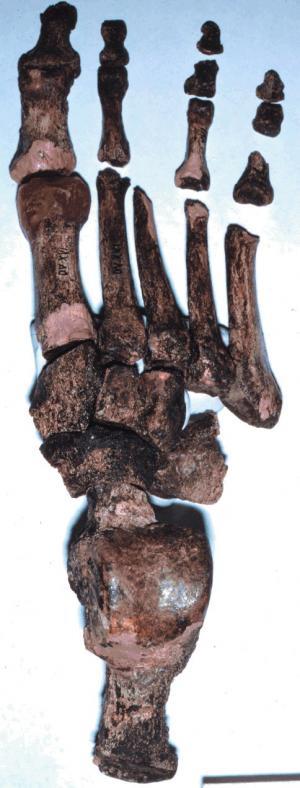
A 26,000 year-old early modern human, Dolni Vestonice 16 from the Czech Republic, showing the reduced strength of the bones of the lesser toes. It is one of three partial foot skeletons from Dolni Vestonice that shows the reduced lesser toe strength, all dating to about 26,000 years ago. (Photo Credit: Erik Trinkaus / Czech Academy of Sciences)


He analyzed the the feet of middle and upper Paleolithic humans and compared the strength of the toes (based on robusticity, size of muscle markings, etc.) with leg strength (I'm assuming this means the tibia and fibula - again based on robusticity, size of muscle markings, etc.). Trinkaus notes that around 30,000 years ago toe strength underwent a reduction while calf strength remained the same. He chalks up this decrease in toe strength to the full time use of supportive footwear:

During barefoot walking, the smaller toes flex for traction, keeping the toe bones strong. Supportive footwear lessens the roll of the little toes, thus weakening them.

Trinkaus is certainly one of the more original thinkers in Paleoanthropology, but I am a little bit skeptical. Granted, I haven't read the article in the October Journal of Archaeological Science (abstract available here - so if someone out there with access wants to send me a copy of the article...?). My first thought on reading the Science Daily article was what about allometry and/or sexual dimorphism?

Added Later: Go here for more.

Read more!

Monday, August 22, 2005

Culture and Chimpanzees

Culture is one of the seminal concepts in anthropology. A lot of people have tried to define it. Starting with E. B. Tyler (one of the founding fathers of anthropology) who defined culture thusly:

"culture or civilization, taken in its wide ethnographic sense, is that complex whole which includes knowledge, belief, art, morals, law, custom, and any other capabilities and habits acquired by man as a member of society"

Others, such as Linton defined culture this way:

"...the sum total of ideas, conditioned emotional responses, and patterns of habitual behavior which the members of that society have acquired through instruction or imitation and which they share to a greater or lesser degree..."

Perhaps one of the best definitions of culture - well more a list of the characteristics that define a culture - was given by Murdock in his 1940 paper for the American Sociological Review entitled "The Cross Cultural Survey". Murdock found that culture could be characterised by the following traits:

1) Culture is learned - that is it is not instinctive or biologically transmitted but is acquired by each individual through their life experiences.
2) Culture is inculcated - The above are transmitted from parent to child over successive generations. This means that not only are techniques and knowledge imparted but mistakes are corrected as well. Consequently, there is a certain amount of indepoedence between the traits being passed and the individual bearers of culture.
3) Culture is social - in other words it is shared between individuals living in groups and is kept uniform via social pressure.
4) Culture is ideational - that is certain kinds of behavior should conform to established precedent. Put another way, there are certain ideal norms or patterns of behavior (think mental template)that the bearers can use to guide their behavior.
5) Culture is gratifying - that is it satisfies - or provides a means for satisfying - biological and psychological neads
6) Culture is adaptive - to both the geographic and social environment
7) Culture is integrative - In other words, the elements of a given culture tend to form an integrated whole - although historical events - such as improved technology - exert a disturbing influence.

One could, and many people have, argue with most of these definitions. There are, however, certain commonalities in most definitions of culture. Especially, the parts about culture being shared and learned. For the longest time, cultural behavior was restricted to humans (implicit in E. B. Tylor's definiton above). For example, it used to be thought that tool use (ala Oakley's "Man the Tool-maker)was a cultural trait restricted to humans. Then tool use among chimps was discovered. Language was another cultural characteristic that - it was thought- resided only in humans. Indeed, most definitions of culture (See Kroeber and Kluckhohn's 1952 book "Culture: A Critical Review of Concepts and Definitions" for over 200 definitions collected from the literature) state overtly or imply that language, and it's ability to transmit acquired knowledge, is necessary for culture to exist. Then it was discovered that chimps, gorillas and orangs could use sign language.

A recent study at the Yerkes National Primate Research Center has cast an interesting light on culture. Researchers devised an ingenious experiment to study cultural transmission in chimps. Rather than trying to create an artificial situation like you see in some of the language experiments (usually with one chimp in isolation), researchers decided to test chimps in a group situation:

In the study, researchers introduced a naturalistic foraging task into three groups (two experimental and one control) to see if chimpanzees can learn by observation. While unseen by other chimpanzees, researchers taught a high-ranking female from each of the two experimental groups a different way, either Lift or Poke, to retrieve food from a system of tubes called Pan-pipes. Once the two females mastered the task, other chimpanzees within their groups were allowed to watch them perform the new skill over a seven-day period before all group members were allowed to use the tool. According to the researchers, group members gathered around the local expert, watched attentively and proved successful when allowed to try the task on their own. The third group, which did not have the benefit of a local expert and was left to decipher the task on its own, was unsuccessful in retrieving food from the Pan-pipes.


The upshot is that:

"This study demonstrates apes do copy members of their own species and they develop different traditions by doing so," said Dr. Horner. "It makes it likely differences in tool use between wild chimpanzee communities in Africa indeed reflect a form of culture and establishes another link between human and chimpanzee societies."


Occassionally, chimps that learned Poke would discover Lift, try it a few times, then revert to Poke. Ditto for chimps that learned lift. This has been taken to indicate a conformity bias among chimps every bit as strong as that among humans:

The conformity bias finding was an unexpected, but equally important, result of this culture study, according to Dr. Horner. A few members of each group independently discovered the alternative method for freeing food from the Pan-pipes, but this knowledge did not endanger the groups' traditions because most of these chimpanzees reverted back to the norm set by their local expert. "Choosing the group norm over the alternative method shows a level of conformity we usually associate only with our own species," said Dr. Horner. "By using the group's technique rather than the alternative method, we see the conformity is based more on a social bond with other group members than the simple reward of freeing the food."


But think about it in terms Murdock's definition of culture given above. The different methods of getting the food were learned, certainly social in that the techniques were shared among members of the group, ideational in that each group had a mental template or norm to guide their behavior, gratifying in that biological needs were satisfied, and adaptive. Whether, the behavior was inculcated, in the sense mentioned above, and integrative remains to be seen because the experiments were short term and you would need a long term study to decide those two questions. What about conformity - something getting this study a lot of attention? According to the study:

A characteristic traditionally thought to be solely human, the propensity to conform, may be part of an evolutionary progression. "These results suggest an ancient origin for the cultural conformism that is so evident in humans," said de Waal. "Further research may reveal these findings to be more widespread throughout the animal kingdom."


One thinks that here people are confusing the modern, stereotypical definition, of conformism ("Like, gaw'd Levi's are soo 15 minutes ago...") with the ideational aspects of culture. Although, in most cultures social pressure can be exerted to insure uniformity, there is room for ideosyncratic behavior. Incidentally, the studies doesn't mention whether or not social means were used to induce conformity. It just says that the chimps that discovered alternate means reverted back to the norm of their group, i. e. the mental template for getting food that they already had.

Interestingly enough, the New Scientist article mentions that the poke method was more efficient at getting food than the Lift method. Chimps that learned Lift but discovered, independently, Poke reverted to Lift. I would like to see more on this before I chalk it up to "conformity", especially because of the way the study is portrayed. "Copycat chimps are cultural conformists" is the title of the New Scientist article. The Science Daily title is better but in reading both pieces I don't get the feeling that the authors really understood the concepts they were discussing.

Leaving the conformity issue aside, what this study does indicate is that we have to look far back in human history to discover the origins of culture - and this study certainly prooves that chimps are culture bearing organisms. It goes without saying that the implications of this study for our understanding the behavior of Australopiths and early Homo will probably need to be revised somewhat.

Cool stuff!

Read more!

Sunday, August 21, 2005

Einstien Manuscript Discovered

A student working on a master's thesis has discovered the original manuscript of one of Albert Einstein's papers. According to the news report:

The paper predicted that at temperatures near absolute zero — around 460 degrees below zero — particles in a gas can reach a state of such low energy that they clump together in one larger "mono-atom."

The idea was developed in collaboration with Indian physicist Satyendra Nath Bose and the then-theoretical state of matter was dubbed a Bose-Einstein condensation.

In 1995, University of Colorado at Boulder scientists Eric Cornell and Carl Wiemann created such a condensation using a gas of the element rubidium and were awarded the Nobel prize for physics in 2001, together with Wolfgang Ketterle of the Massachusetts Institute of Technology.


Cool!

Read more!

Friday, August 19, 2005

Friday Chimpanzee Blogging: The Origins of Brain Lateralization

One of the more interesting subjects paleoanthropologists are interested in is the evolution of the brain. More particulary, they are interested in the origins brain lateralization. A researcher associated with Yerkes National Primate Research Center thinks she has found the beginnings of an answer.

Elizabeth Lonsdorf studied 17 chimps at Gombe National Park in Tanzania:

She and colleague William Hopkins noted which hand mothers and offspring used and found most of the chimpanzees showed a clear preference for one hand or the other, with the majority being left-handed.

Furthermore, they determined the handedness trait runs in families, with females tending to produce offspring with the same hand preference.


They also note that:

"...wild chimpanzees are usually left-handed and pass that preference to their offspring, while chimps in captivity are usually right-handed."


The above is a picture of a chimp in a zoo - note it is holding a tube in it's left hand and using a tool to fish out treats in it's right hand.


The above picture is of a chimp in the wild, unfortunately, it is using a tool in it's right hand as well. One picture, I hasten to add, does not invalidate the theory. At any rate, this suggests that the beginnings of brain lateralization was present before the split between humans and chimpanzees and occured at least five million years ago. One of the interesting aspects to come from the Study is that:

Another interesting aspect of the new research is that it demonstrates chimpanzees learning by imitation. The adult females studied each had quite distinct patterns of using short, medium and long fishing tools to varying degrees. The lengths of tool used by daughters greatly resembled their mothers’ choices, whereas the sons’ did not. “Obviously they are paying attention to their mother’s technique, while the sons are not,”


Here is a link to some interesting, short, movies of chimps:

Images of Life on Earth

Read more!

Wednesday, August 17, 2005

Baby Octopi Blogging: An Aurora Update

Regular readers of my blog may remember this post on Aurora the octopus. To refresh your memory:

A month later, Aurora laid tens of thousands of eggs. Her sense of mothering was strong, despite the fact that her eggs didn't appear to develop and aquarists eventually believed they were sterile.


Day in and day out, she sucked in water through her mantle and sent waves of cleansing water over the eggs. She defended them against hungry sea cucumbers and starfish.


I have checking from time to time to see if I can find more information on Aurora and I finally have some, slightly old (it's dated 7/3/05) news concerning Aurora and her offspring:

Aurora's eggs appear to have mostly hatched out with a few clusters still containing embryos still to emerge. Aurora has become more active again, often seen stretching out across the tank window. The numbers of emergent paralarvae vary daily but the end of the hatch appears in sight.


Paralarva count on May 30 – 178 babies swimming and feeding in their rearing tank and they appear to have hearty appetites.

Most of these little swimmers were transferred from a separate group of Aurora’s eggs housed in a holding tank. However, Aurora’s own egg brood also continues to emerge in view of SeaLife Center visitors. This photo shows her Monday afternoon after a short bit of activity twirling her arms and casting off old sucker disk skin. She momentarily opened up her arms widely enough to allow a better examination of a few of her many remaining unhatched eggs.

Currently, the paralarvae are eating suspended daphnia and live brine shrimp nauplii larvae periodically pulsed into the rearing tank. In addition, many of the baby octopuses are now also able to rip pieces off of small shrimp suspended in the rearing tank for a few hours. This latter food item is easy to add and remove before it becomes a mess to clean up. We are still testing and evaluating various food types recognizing that probably no single food item may be a universal diet. The oncoming challenge will be anticipating and matching different foods to the growing animals’ changing food preferences.


As for the developing paralarvae held elsewhere in the SeaLife Center, we are working with a group that now contains 90+ individuals in a rearing system designed for feeding and long-term rearing. Our aquarists report there are some that have grown larger noticeably feeding on a diet of mashed krill, Mysis shrimp and clam.
Additionally many more of Aurora's brood have been added to an outdoor tank with natural plankton production during the long Alaska summer days to more or less fend for themselves. This group is less accessible for frequent evaluation until later in the year but may surprise us with survivors that grow and settle out of the water column to live on the tank bottom.


So apparently, as of July third Aurora was still alive! Which is good as in my last post I mentioned there was some indication that she might die. That's one tough, determined octopus!


According to MSNBC this is an actual picture of Aurora.

And here is a series of pictures showing the development of the baby octopi.


Are they not the cutest things you have ever seen? Well, okay Aye-Ayes are cuter but these run a close second!

Read more!

Tuesday, August 16, 2005

Why is the DNA Code Based on Codons

As everybody knows the genetic code is based on deoxyribonucleic acid (DNA). The DNA is composed of four different molecules arranged in codons with three per codon. Consequently, there are 64 possible arrangements of three molecules each. Each codon codes for one of 20 different amino acids, which in turn can make an almost infinite number of proteins. Since there are 64 arrangments but only 20 amino acids are used there is a certain amount of redundancy in the genetic code. One of the more interesting questions in genetics is how such a system developed. Recent research is beginning to answer that question.

One of quirks of the genetic code is that there are groups of codons which all translate to the same amino acid. For example, the amino acid leucine can be translated from six different codons whilst some amino acids, which have equally important functions and are translated in the same amount, have just one.

The new theory builds on an original idea suggested by Francis Crick - one of the discoverers of the structure of DNA - that the three-letter code evolved from a simpler two-letter code, although Crick thought the difference in number was simply an accident “frozen in time”.

The University of Bath researchers suggest that the primordial ‘doublet’ code was read in threes - but with only either the first two ‘prefix’ or last two ‘suffix’ pairs of bases being actively read.
By combining arrangements of these doublet codes together, the scientists can replicate the table of amino acids - explaining why some amino acids can be translated from groups of 2, 4 or 6 codons. They can also show how the groups of water loving (hydrophilic) and water-hating (hydrophobic) amino acids emerge naturally in the table, evolving from overlapping ‘prefix’ and ‘suffix’ codons.

“When you evolve our theory for a doublet system into a triplet system, you get an exact match up with the number and range of amino acids we see today,” said Dr van den Elsen, who has worked with Dr Stefan Babgy and Huan-Lin Wu on the theory.


One of the more interesting aspects of this is that it explains how the genetic code can maintain it's integrity. Because, for example, translation errors can result in another amino acid with the same charactersitics. Even more interesting is it's prediction about two amino acids (glutamine and asparagine). Both denature (or melt) at lower melting points than the other amino acids and researchers suggest that both were added somewhat later in evolution:

One possible reason for this is that the Last Universal Common Ancestor (LUCA), which evolved into all life on earth, lived in a hot sulphurous pool or thermal vent. As it moved into cooler conditions, it was able to take up these two additional amino acids and evolve into more complex organisms. This provides further evidence for the debate on whether life emerged from a hot or cold primordial soup.


Support for the theory comes from the fact that several aminoacyl-tRNA synthetases link with pairs - rather than triplettes - of bases during translation:

“There are still relics of a very old simple code hidden away in our DNA and in the structures of our cells,” said Dr van den Elsen


Which, of course, provides an avenue for future research.

I wonder what Intelligent Design advocates will make of this since it is a good example of how information content can be increased via natural selection. Something that Intelligent Design advocates say is impossible.

Read more!

Monday, August 15, 2005

Is It Worth It?

It seems the goals the administration has for Iraq keep changing. It started with WMD, then changed to Sadam was an evil that had to be destroyed, went to making Iraq a shining beacon of democracy -via draining the swamp- that will change the face of the mideast. Over the last couple of weeks it has changed again, schizophrenically divided between two competing visions.

From WAPO (via Eschaton):

The United States no longer expects to see a model new democracy, a self-supporting oil industry or a society in which the majority of people are free from serious security or economic challenges, U.S. officials say.

"What we expected to achieve was never realistic given the timetable or what unfolded on the ground," said a senior official involved in policy since the 2003 invasion. "We are in a process of absorbing the factors of the situation we're in and shedding the unreality that dominated at the beginning."

Administration officials still emphasize how much they have achieved despite the chaos that followed the invasion and the escalating insurgency. "Iraqis are taking control of their country, building a free nation that can govern itself, sustain itself and defend itself. And we're helping Iraqis succeed," President Bush said yesterday in his radio address.

Iraqi officials yesterday struggled to agree on a draft constitution by a deadline of tomorrow so the document can be submitted to a vote in October. The political transition would be completed in December by elections for a permanent government.

But the realities of daily life are a constant reminder of how the initial U.S. ambitions have not been fulfilled in ways that Americans and Iraqis once anticipated. Many of Baghdad's 6 million people go without electricity for days in 120-degree heat. Parents fearful of kidnapping are keeping children indoors.

Barbers post signs saying they do not shave men, after months of barbers being killed by religious extremists. Ethnic or religious-based militias police the northern and southern portions of Iraq. Analysts estimate that in the whole of Iraq, unemployment is 50 percent to 65 percent.

U.S. officials say no turning point forced a reassessment. "It happened rather gradually," said the senior official, triggered by everything from the insurgency to shifting budgets to U.S. personnel changes in Baghdad.

The ferocious debate over a new constitution has particularly driven home the gap between the original U.S. goals and the realities after almost 28 months. The U.S. decision to invade Iraq was justified in part by the goal of establishing a secular and modern Iraq that honors human rights and unites disparate ethnic and religious communities.

But whatever the outcome on specific disputes, the document on which Iraq's future is to be built will require laws to be compliant with Islam. Kurds and Shiites are expecting de facto long-term political privileges. And women's rights will not be as firmly entrenched as Washington has tried to insist, U.S. officials and Iraq analysts say.

"We set out to establish a democracy, but we're slowly realizing we will have some form of Islamic republic," said another U.S. official familiar with policymaking from the beginning, who like some others interviewed would speak candidly only on the condition of anonymity. "That process is being repeated all over."
(emphasis mine). Apparently, Cindy Sheehan's son died so an Islamic Republic could be built in Iraq. Or maybe he died because of "...the unreality that dominated at the beginning...". If this is too gloomy an assesment for you take comfort. There is another reason for the invasion. Also from WAPO:

Pessimists increasingly argue that Iraq may be going the way of Lebanon in the 1970s. I hope that isn't so, and that Iraq avoids civil war. But people should realize that even Lebanonization wouldn't be the end of the story. The Lebanese turned to sectarian militias when their army and police couldn't provide security. But through more than 15 years of civil war, Lebanon continued to have a president, a prime minister, a parliament and an army. The country was on ice, in effect, while the sectarian battles raged. The national identity survived, and it came roaring back this spring in the Cedar Revolution that drove out Syrian troops.


One has to ask, though, if that is enough to justify this from the New York Times:

When you talk to close relatives of men and women who have been wounded in the war, it's impossible not to notice the strain that is always evident in their faces. Their immediate concern is with the wounded soldier or marine. But just behind that immediate concern, in most cases, is the frightening awareness that they have to try and rebuild a way of life that was also blown apart when their loved one was wounded.

Ms. Olson, who is 45 and divorced, gave up everything - her work, her rented townhouse, her car - and moved from Tacoma to a hotel on the grounds of Walter Reed to be with her son and assist in his recovery.

"He was still in a coma when I got here," she said. "He didn't have his eyes open, and he was hooked up to all the machines. When he did open his eyes a couple of days later, he didn't respond. His eyes didn't follow me. That was a scary moment. But the following day his eyes started following me."

Corporal Rosendahl has improved a great deal since those days and recently has been allowed to go with his mother on brief excursions away from the hospital. "It's difficult for him," Ms. Olson said. "But in those first weeks here he couldn't move a finger. So this gives me so much hope."

Ms. Olson is a paralegal who did work for several lawyers in Tacoma. She also worked as a claims analyst for the city's transit system. With that work gone, she is now living on the $48 per diem she receives from the Army for food and lodging, along with money that she has reluctantly been drawing from her son's Army pay, and assistance she is receiving from another son, Keith, who is 27.

She has also received help from charitable organizations that assist military families.

"My son is the most important thing," she said, "and I knew that if I was going to be with him, I wouldn't be able to meet my financial obligations."

So she gave up the townhouse and "turned in" a Honda Accord that she had purchased just a year earlier. "Voluntary repossession," she said.


Voluntary repossession...now that your son is of no further use you can have him back...voluntary repossession...but not before you give up your livelihood, not before you give up your house and your car...voluntary repossession...oh and here's 48 bucks - hope it helps.
It isn't right that so many have paid so much for so little.

Read more!

The Simpsons and Religion

Last nights episode had Homer and Bart converting to Catholicism. Marge, at one point, kidnaps Bart to try and show him that Protestants can have fun too. Says Homer "why does she always interfere with my occassional interest in my children" and wants to know why he can choose his own faith. Lisa chimes in with something to the effect that everybody has the right to choose their own religion "...that's why I choose Buddhism..." she says. A nearby catholic priest says "Yes, every child has an imaginary friend" I almost fell out of my chair I was laughing so hard at the irony.

Read more!

Sunday, August 14, 2005

Earth's Early Atmosphere and the Search for Life on other Planets

Model Gives Clearer Idea Of How Oxygen Came To Dominate Earth's Atmosphere

Researchers interested in how earth's atmosphere came to be dominated by oxygen have come up with an interesting model to explain why there was a lag between the origin of photosynthesis and the domination of earth's atmosphere by oxygen.

There were several processes at work. First, gasses emitted from volcanoes combined with the oxygen and acted as an oxygen sink. Second, oxidation of iron from space bombardment acted as a second sink. Researcers found that varying the estimates of iron content in the earth's crust could change the time frame by up to a billion years in one direction or the other.

Here is how it works:

Earth's oxygen supply originated with cyanobacteria, tiny water-dwelling organisms that survive by photosynthesis. In that process, the bacteria convert carbon dioxide and water into organic carbon and free oxygen. But Claire noted that on the early Earth, free oxygen would quickly combine with an abundant element, hydrogen or carbon for instance, to form other compounds, and so free oxygen did not build up in the atmosphere very readily. Methane, a combination of carbon and hydrogen, became a dominant atmospheric gas.

With a sun much fainter and cooler than today, methane buildup warmed the planet to the point that life could survive. But methane was so abundant that it filled the upper reaches of the atmosphere, where such compounds are very rare today. There, ultraviolet exposure caused the methane to decompose and its freed hydrogen escaped into space, Claire said.

The loss of hydrogen atoms to space allowed increasingly greater amounts of free oxygen to oxidize the crust. Over time, that slowly diminished the amount of hydrogen released from the crust by the combination of pressure and temperature that formed the rocks in the crust.

"About 2.4 billion years ago, the long-term geologic sources of oxygen outweighed the sinks in a somewhat permanent fashion," Claire said. "Escaping to space is the only permanent escape that we envision for the hydrogen, and that drove the planet to a higher oxygen level."


The most intersting part of the article is the last sentence:

"There is interest in this work not just to know how an oxygen atmosphere came about on Earth but to look for oxygen signatures for other Earth-like planets," Claire said.


Note that the one thing missing in this search for life on other planets is Intelligent Design

Read more!