Monday, November 21, 2005

Magnetic Bacteria


The above is a picture of Magnetospirillum gryphiswaldense a unique type of bacteriathat is magnetotactic. That is it uses the earth's magnetic field to find suitable environmental conditions. How does it work? Well, Magnetospirillum absorb large amounts of iron to produce an oxide called magnetite. The magnetite is formed into magnetosomes which are strung out in a chain.


This raises two interesting questions. First, what are the genetics behind it? Second, how does the bacteria accomplish this? The two questions are related. Researchers, at the Max Planck Institute, first focused on identifying the part of the DNA that carried the code for magnetosome formation. They found a fragment containing about 25-30 different magnetosome genes. One gene had a product (MamJ) that was similar to proteins that control crystallization processes in bones, teeth and mussel shells among others. Once this gene was removed they discovered something interesting.


The picture on the left shows normal bacteria, the one on the right shows mutant bacteria with the Mamj gene disabled. Notice the magnetosomes form a straight chain in the normal but are clumped in the mutant. What was going on here? Researchers then used a relatively new technique called cyroelectron tomography to examine the magnetosome chain in more detail. This is what they saw:


The blue is cell membrane, the red are the magnetosomes, the green is a previously unknown filamentous structure (resembling a cytoskeleton)and the yellow is the MamJ product. Apparently, the MamJ product develops on the magnetosome and the filament and this is what allows them to form a chain. In the mutant bacteria, which lacks the MamJ, the magnetosomes clump toghether one they reach a certain size. This is fascinating, but there is an interesting evolutionary wrinkle. Some organisms, such as salmon and homing pidgeons, also orient themselves to magnetic fields. Interestingly, they also have magnetite chains in some of their tissue and may develop through similar mechanisms. I eagerly await further developments.

For more info:

Science Daily

The Press Release (where some of the pics and info for this post came from)

Magneto-Lab: Research(where some of the pics and info for this post came from)


The Research is also being published in Nature, Advanced Online Publication, November 20, 2005

Read more!

Sunday, November 20, 2005

Kansas Needs Your Help

Added Later: I'm keeping this at the top for awhile.

I don't know how many of my readers live in Kansas, but if you do I would like to direct your attention to two posts at Red State Rabble. In the first we learn:

"In private interviews with employees," reports Rothschild, "the transition team, appointed by Corkins after he was hired last month, has asked, 'What is your general reaction to school choice, charter schools and parental empowerment?'”

"Christy Levings, president of the Kansas-National Education Assn., said the question was unfair," according to Rothschild.

“'It’s a difficult position to put state employees in,' Levings said because Corkins is a known supporter of vouchers, which allows the use of state tax dollars to send students to private schools."

As the appointment of Corkins, the hiring of David Awbrey, and the contract with Harden demonstrate, political loyalty -- not competence -- will now be the standard by which all things are judged at the department of education.


I, for one find this appalling and urge you, if you live in Kansas, to stand up and make a difference. From the second post:

The painful irony for Kansans is that opposition to public education -- once the preoccupation of a few isolated individuals on the lunatic fringe -- is now being organized out of the State Board of Education and by the top administrators in the Kansas State Department of Education.

That is why it is absolutely essential for the people of Kansas -- the overwhelming majority of whom take justifiable pride in the state's history of support for public education -- to take the state school board away from the fanatics who now control it and put it back into the hands of experienced adults.


I urge those of you who don't live in Kansas to read these to posts and take notes because if this works in Kansas in will be showing up in your state next. It is time to stand up and put a stop to this kind of nonsense - whether you live in Kansas or not. To that end let's take Pat Hayes' advice and donate to those who are striving to keep rationality in education:

To win, McDonald believes he will have to raise nearly $100,000. He needs your help. RSR strongly urges supporters of public education in Kansas to support McDonald by writing a check to the Committee to Elect Harry McDonald and sending it to 11917 W. 143rd St., Olathe, KS 66062.

If you live out of state, as many RSR readers do, you should remember that much of the funding for the far right candidates will come from wealthy out-of-state donors who give regularly to right-wing causes.


Several blog sites have made much ado about supporting bloggers but this is so much more important. Please give what you can to the address above (Pat says he will be talking about other candidates in the coming weeks and I urge you to watch for them and donate whatever you can). I, personally, live from paycheck to paycheck but am going to donate $20 to Mr. McDonald out of my next paycheck (I'll let you know when this happens) and challange my readers to donate (no set amount - whatever you can) as well.

Read more!

This and That

Pharyngula links to an intersting version of the big bang.
He also links to a warning label generator here is my attempt:


Read more!

Saturday, November 19, 2005

Transitions: Site of the Week

I have instituted a new "Site of the Week" category over at Transitions (which I hope will actually be weekly).

You can find out about the first site here. As always if you have a post that you think will fit with the mission of Transitions drop me a line. For example, if somebody had an interesting post on theEvolution of the Cichlid Mandible... or some such (you can also consult the posts already up for examples of what I am looking for).

I am also on the look out for more sites to link to, please consult the list of links at Transitions to get an idea of what I'm looking for. I'm especially interested in finding the following: interactive sites, sites with activities that teachers can bring into the classroom and sites dealing with the evolution of organisms other than hominins. This later is particularly important since at the moment there is a pronounced bias towards human evolution. So, if you know of any good sites relating to the evolution of you favorite organsism (note: I also don't have much on invertebrates, viruses, etc.)leave a link in the comments section or email me. I should also mention that I'm looking for links on the "Cambrian Explosion".

Read more!

Most People Want Evolution Taught In Schools!

A recent poll by Scripps Howard/Ohio University finds that even though 54% of the people surveyed believe that "God" created the world in six days:

"Sixty-nine percent agreed that evolution is what most scientists believe, so it should be taught in public school science classes..."


Now the bad news. 20% think scientists are wrong about evolution and about half agree with Bush that Intelligent Design should be taught alongside evolution.

Read more!

I Know What Santa afarensis is Getting Me for Christmas


Cool, ain't it!

Read more!

Thursday, November 17, 2005

Intelligent Design and Human Origins:The Final Post

I have been discussing Casey Luskin's article "Human Origins and Intelligent Design" in a series of posts. My last one covered Luskin's views on Eocene primates. I'm going to skip his, brief, discussion of the Miocene and jump strait to the hominins. The first thing that stands out is his total misunderstanding of the role of Ramapithecus in current paleoanthropological thinking. Luskin's article was written in 2004, yet we still find him talking about Ramapithecus as a human ancestor. Once upon a time, Ramapithecus used to be considered a human ancestor (for example, by Richard Leakey in his book "People of the Lake: Mankind and it's Beginings"), however, by the 1980's molecular evidence and cladistic analysis indicated this was incorrect. As a matter of fact Ramapithecus, as a taxon, was sunk into Sivapithecus (a species related to the Orangutan).

It gets better. By 2004 the following species of early hominin were known:

Ardipithecus ramidus ramidus
Ardipthecus ramidus kadabba
Australopithecus anamensis
A. afarensis
A. garhi
A. barelgazeli
A. aethiopicus
A. robustus
A. africanus
A. boisei

Additionally,
Kenyanthropus platyops
Orrorin tugenensis

Yet all we here about from Luskin is A. afarensis, A. africanus, A. robustus and A. boisei (he does mention Ardipithecus ramidus). In reading the article, one gets the distinct impression that Luskin really doesn't understand the material he is discussing (more on this in a bit). After giving the creationist arguement about Oxnard an australopith locomotion. After which he starts in on "Lucy" :

Other recent studies have found that the handbones of Lucy are similar to those of a knucklewalking ape. (pg. 7)

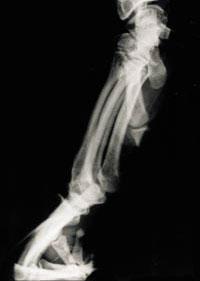
At which point he cites two articles, one a 2000 paper by Collard and Aiello and the other a 1971 paper by Richard Leakey - the citing of which is an example of really poor scholarship. However, let's address the question head on. Assume that A. afarensis was a knucklewalker, does this rule out a possible ancestor-descendent relationship with Homo? This is a good example of where Luskin really doesn't understand the material he is discussing. Among primates three species knucklewalk. Chimps, gorillas and orangs (more or less). In chimps and gorillas, when knucklewalking, the weight is born on the middle phlanges


primarily of the second and third digits. Below is a picture of knucklewalking.


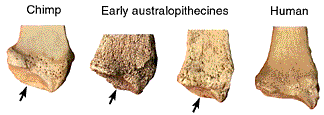
Technically, orangutans, when on the ground, fist-walk. Their hand is curled into a fist and the weight is primarily born on the proximal phlanges. Because of this chimps, gorillas and orangs have certain modifications to their hand and wrists to allow for stability and weightbearing. In chimps and gorillas the radius is concave and the distal edge projects downwards to form an edge which abuts a ridge on the scaphoid (in humans this is not the case - see the picture above). Below is a picture comparing the radius of a chimp, early australopiths and humans.


Additionally, the metacarpals have transverse ridges that abut the proximal phlanges and more or less lock them in place. Orangutans hands and wrists are more adapted to suspensory activity. One side note, pygmy chimps have hand and wrist morphology intermediate between Chimps and gorillas ont the one hand and orangs on the other. A. afarensis lacks these features (except perhaps the concave radius with a distal projecting edge). Molecular and anatomical evidence indicates humans are closely related to the african apes. In particular, humans are more closely related to chimps than to gorillas and are more closely related to african apes than to the orang. The larger question, then, is one of trait polarity and it's implications for human evolution. If the common ancestor of orangs, gorillas and chimps was a knucklewalker then the condition is a shared primitive trait in the apes and humans have a derived condition. It gets trickier. For example, if the common ancestor of chimps and humans was a knucklewalker and the common ancestor of gorillas and chimps was not what does that say? Well, this would imply that knucklewalking evolved independently in chimps and gorillas but was lost in humans. Either way, it has no impact on the question of whether A. afarensis and humans are evolutionarily related.
He then mentions semicircular canals, which I have discussed here.

Luskin then jumps to Homo habilis and again displays poor scholarships and a total lack of understanding of the material he is discussing. Consider the following:

H. habilis remains were first discovered in 1960, and were named in 1964 by famous paleoanthropologist Richard Leakey and his team. (pg. 9)


Hello, excuse me? Let's explore. A new Species of Genus Homo from Olduvai Gorge, Leakey, L. S. B., Tobias, P. V. and Napier, J. R. He actually cies two papers for the claim. One being Stern and Susman's paper on The Locomotor Anatomy of Australopithecus afarensis published in vol 60 of the AJPA (he gets the page numbers wrong in his citation by the way). I have a copy of the Stern and Susman article and nowhere in it do they say that Richard Leakey discovered Homo habilis since, of course, they both know Louis Leakey discoverd H. habilis.

Even worse is his mangling of Wood and Collard's paper "The Human Genus". At this point I had encountered so many errors and spent so much time tracking down sources that I just gave it up as being a bad job. I have heard people say debunking this kind of writing takes a lot more time and energy than it took to write it, but I didn't believe it until now. One thing more, though, Luskin makes much of the sudden emergence and rapid development of various groups of primates, hominins etc, and given Dembskii's recent preoccupation with Stephen Gould one wonders if the next incarnation of creationism/ID might not be some sort cheap imitation of punctuated equilibria. Might explain ID advocates recent attempt to say Gould didn't believe in natural selection.

If you wish to torture yourself with bad scholarship and worse paleoanthropology (most first year anthro students have a better understanding of the material) you can find Luskins article here.

Read more!

Wednesday, November 16, 2005

Turtle Fossils

While I'm on the subject of fossils...
The BBC has some interesting pics of fossil turtles.


This one is a juvenile:


From the accompanying article:

Representatives of the turtle lineage are known from the fossil record as far back as 200 million years. But these examples look more like tortoises, suggesting they were still very much adapted to life on land.

The latest find has front feet shaped like paddles, much like modern turtles.


Which kind of sounds like a transitional fossil to me, but I coould be wrong.

"Tortoises have very short foot bones and not very much soft tissue," lead author Sarah Fielding, of the school of Earth and environmental sciences at Portsmouth, told the BBC News website.

"This specimen has slightly longer foot bones and quite a lot of webbing in between."


Nope, I was right...

"We're fortunate the deposit it was found in has fine mud which has preserved the webbing - which is quite rare for turtles."

But the hind feet in this specimen seem to be more tortoise-like, suggesting this creature was not fully adapted to a marine lifestyle and spent some significant amount of time on land.


Researchers determined the turtle was a new species, which they named Araripemys arturi.

Read more!

New Transitional Fossil Found: Dallasaurus turneri

Added Even Later: John Wilkins at Evolving Thoughts has some interesting thoughts on the subject as well.
Added Later: The Hairy Museum of Natural History has more. Including links to pics of the fossil, the paper it was described in and more!

The mosasaurs are species of aquatic reptiles that are related to lizards (to be more precise the varanoid lizards - of which the Komodo dragon is a good example). During the upper cretaceous they reached their peak. Almost 20 genera are recognized for this period with the largest approaching 30 feet. They were ocean going carnivores that ate almost anything that swam in the sea. Below are some representitive species.


And here are some fossils.


One with a person in it for scale.


However, we are not concerned with one of the larger species. We are interested in a little three foot long specimen discovered in Texas. Most Mosasaurs have flippers, Dallasaurus turneri has limbs similar to other land lizards. From Science Daily:

Until the discovery of Dallasaurus, however, only five primitive forms with land-capable limbs were known, all of them found in the Middle East and the eastern Adriatic.


*snip*

The advanced fin-bearing mosasaurs have been grouped into three major lineages. Although a small number of primitive mosasaur have been known to retain land-capable limbs, they were thought to be an ancestral group separate from the later fin-bearing forms. Dallasaurus represents a clear link to one lineage of the later forms and the first time researchers can clearly show mosasaurs evolved fins from limbs within the different lineages of mosasaurs.


I was unable to find any pictures of the fossil, but here is a reconstruction of what it is believed to look like.


For a quick overview of Mosasaurs you can do no better than Oceans of Kansas

Read more!

Monday, November 14, 2005


“The size of these specimens – the crown of the molar, for instance, measures about an inch across – helped us understand the extraordinary size of the primate" so this tooth is about twice the actual size!

The above are pictures of Gigantopithecus fossils. Gigantopithecus is a genus composed of two species G. blacki and G. giganteus. G. giganteus lived during the Late Miocene/Early Pliocene and G. blacki is known from the Pleistocene and both are generally considered to be the largest primates ever. Incidentally, G. giganteus is considered to be directly ancestral to G. blacki (so they are really a chrono species). They are estimated to have reached 10 feet in height and about 1,200 pounds in weight. Most specimens come from the Siwalik hills in Pakistan and India. Currently it is thought that Gigantopithecus is actually related to the orangutans, via Sivapithecus (a widespread genus that contains all of the material previously reffered to as Ramapithecus - but that's a long story). At any rate, recent research has thrown an interesting wrinkle into the story:

Using a high-precision absolute-dating method (techniques involving electron spin resonance and uranium series), Jack Rink, associate professor of geography and earth sciences at McMaster, has determined that Gigantopithecus blackii, the largest primate that ever lived, roamed southeast Asia for nearly a million years before the species died out 100,000 years ago. This was known as the Pleistocene period, by which time humans had already existed for a million years.


So it's possible that anatomically modern humans would have encountered them (certainly H. erectus would have also).

Read more!

Saturday, November 12, 2005

Papers I Have Read This Week

The Position of Hippopotamidae Within Cetartiodactyla
PNAS 102:1537-1541. Fascinating discussion of the phlogeny of Hippos (apparently, they are related to whales). I'll probably do a post about it - maybe on Transitions

Coding Sequences of Functioning Human Genes Derived Entirely from Mobile Element Sequences.
PNAS 101:16825-16830. The title pretty much says it all.

The Rate of DNA Evolution: Effects of Body Size and Temperature on the Molecular Clock
PNAS (yes I've been reading a lot of PNAS lately) 102:140-145. Interesting article that ties in with this post. It explores the impact of body size, temperature and metabolic activity (the first two affect the third) on nucleotide substitution rates. Absolutely fascinating and I will be doing a post on it.

Molecular Origins of Rapid and Continuous Morphological Evolution.
ONAS 101:18058-18063. Pharyngula did a great post on this paper.

Modeling Gene and Genome Duplications in Eukaryotes
PNAS 102:5454-5459. Actually, I'm still in the process of reading this one.

A Hominid from the Lower Pleistocene of Atapuerca, Spain: Possible Ancestor to Neandertals and Modern Humans.
Science 276:1392-1395. Discussion of the Gran Dolina fossils. Places them in a new species (Home antecessor).

Read more!

Thursday, November 10, 2005

Evo-Devo and Cichlids

Added Later: Pharyngula has a fascinating post on the same subject. A must read!


The above is a picture of a cichlid. I have blogged about them before. A new studies illustrates the link between evolutionary development and embryonic development in the jaws of cichlid fishes. From Science Daily:

In a study illustrating the apparent linkages between the evolutionary development and embryonic development of species, researchers have uncovered the genetic elements that determine the structure and function of a simple biomechanical system, the lower jaw of the cichlid fish. In addition, they've shown that increasing expression of a particular gene in an embryo can lead to physical changes in the adult fish. The results appear in the November 11, 2005 issue of the Proceedings of the National Academy of Sciences.


Researchers predicted that functionally or developmentally related componets of the cichlid jaw would be controlled by the same set of genes. The researchers compared two species of cichlid from Lake Malawi:

One species had force modified jaws that are more adept at biting prey; the other had speed modified jaws, which are more accomplished at using suction to feed on plankton. Each jaw system is essentially a lever system made up of one out-lever and two in-levers.

The predator cichlid is the first picture above. Below is a picture of the plankton eating cichlid.


But when the researchers mapped the part of the genome that controlled the system they found that the levers were controlled by genes on different chromosomes (i.e. the short lever genes are on a different chromosome than the long gene). Or to phrase it another way:

“We were surprised to see that the genetic basis of components involved in opening the jaw is independent of the jaw-closing system,” said Streelman. (one of the researchers involved - afarensis)


Taking it a step further:

In another part of the study, researchers showed that the gene bmp4 is a major factor in controlling the jaw-closing system. When the team injected bmp4 protein into the developing embryos of another fish species, the zebrafish, they saw that the mechanical advantage (and thus the biting power) of the jaw increased.


The researchers sum up their work thusly:

"We've demonstrated that important functional differences operating in adult organisms are elicited by changes in early development. Our next goal is to understand the genetic bases underlying the differences between the simple biomechanical system of the lower jaw and complex systems of the anterior jaw in these fish."

Read more!

Intelligent Design Thread on the St. Louis Post-Dispatch Blog: Could it be Kent Hovind?

The St. Louis Post-Dispatch Blog has another thread on Intelligent Design The question posed to start the thread was:

Supporters of the change (introduced by the Kansas Board of Education - afarensis) say it promotes “academic freedom.” Opponents, that it unconstitutionally will introduce religion into a public school framework.

Further, the standards would rewrite the definition of science, so that it is no longer limited to the search for natural explanations of phenomena.

What is science? Do you have a clear idea of the definition of science? What makes one thing a scientific theory, but another religious dogma?


It has attracted the usual hodgepodge of people both for and against, but one comment (257) stands out. It reads, in part:

The test of any theory is whether or not it provides answers to basic questions. Some well-meaning, but misguided, people think evolution is a reasonable theory to explain man’s questions about the universe. Evolution is not a good theory—it is just a pagan religion masquerading as science. The following questions were distributed to the 750-plus people who attended my debate at Winona State University in Winona, Minnesota, on January 9, 1993. (The videotaped debate is #6, $9.95.) Questions added since the debate remarked with an asterisk (*).

1. Where did the space for the universe come from?

2. Where did matter come from?

3. Where did the laws of the universe come from (gravity, inertia, etc.)?

4. How did matter get so perfectly organized?

5. Where did the energy come from to do all the organizing?

6. When, where, why, and how did life come from non-living matter?

7. When, where, why, and how did life learn to reproduce itself?

8. With what did the first cell capable of sexual reproduction reproduce?

9. Why would any plant or animal want to reproduce more of its kind since this would only make more mouths to feed and decrease the chances of survival? (Does the individual have a drive to surviv e, or the species? How do you explain this?)

10. How can mutations (recombining of the genetic code) create any new, improved varieties? (Recombining English letters will never produce Chinese books.)


After scrolling past a bunch more of this junk you find the comment mas made by Matthew. Click on the name Matthew and you end up at www.drdino.com. I vaguely recall seeing a list of questions exactly like this and I want to say it was by Kent Hovind - does anybody out there have any info on this list of questions?

Read more!

Crocodiles and Godzilla!


The above is a picture of a new fossil crocodile discovered in South America. Christened Dakosaurus andiniensis, the crocodile lived about 135 mya.

Here's another pic.


From MSNBC:

"This species was very unusual, because other marine crocodiles that were around at the same time had very delicate features – long, skinny snouts and needle-like teeth for catching small fish and mollusks," said Ohio State University researcher Diego Pol, who determined the crocodile lineage. "But this croc was just the opposite. It had a short snout, and large teeth with serrated edges. It was definitely a predator of large sea creatures."

It has been nicknamed "Godzilla". It sheds some interesting light on crocodile evolution:

"This [animal] forms a very distinct lineage that appears early on in the evolutionary history of crocodiles—invading the sea and showing outstanding adaptation to the marine environment," Pol said.

Unlike today's crocodiles, Dakosaurus andiensis lived entirely in the water. It measured 13 feet (4 meters) from nose to tail. Instead of legs, Dakosaurus had four paddle-like limbs, used mostly for stability. A fish-like tail propelled the beast through the water.

What made it especially unusual was its snout and teeth.
The animal's unusual features suggest that it had completely different feeding habits from its relatives. While other marine crocs fed on small fish, Dakosaurus hunted for marine reptiles and other large sea creatures, using its jagged teeth to bite and cut its prey.

"The most perplexing thing about the animal is that its head shape does not appear to be well suited to a fast swimming crocodilian, because rather than being streamlined, it is somewhat high and flattened from side to side," said Clark, who was not involved with the research.

"Presumably it moved its head mainly up and down rather than sweeping it from side to side, like fish-eating crocodilians."


New Scientist also has a story on it.

Here is another pic:


Added Later: Welcome Pharyngulans! I have added some more stuff below. Also, for your viewing pleasure (and to satisfy those unhealthy cravings for squid pictures here is a link to the video).


And yet more:


A closer view of one of the pics above:


The relationship between Dakosaurus andiniensis and other crocodylians:


The original press release can be found here

Read more!

Humboldt Squid Video

National Geographic has an interesting story on filming Humboldt Squid - complete with video here

Read more!

Tuesday, November 08, 2005

Intelligent Design and Human Evolution

The Dover trial is in the hands of the judge and in Kansas the fundies have approved the destruction of their education system. Meantime, Dembski is hallucinating loudly about the stunning legal strategy he provided the Thomas More Law Center (giggle), apparently we have him to thank for the endless amusement obtained from reading the transcripts of the trial - available here.
I think the scientists came off just a little bit better the Dembski's people (giggle).

At any rate, now seems to be a good time to continue my series on Intelligent Design and Human Evolution.

The Fossil Record of Non-Hominid Primates

As I pointed out, in a very simplistic overview here, here and here the study of primate evolution is quite rich with many theories, debates and fossils. How does Luskin describe this? First, it is immediately obvious that Luskin does not really understand the material he is writing about. For example he states that the "...standard primate phylogeny, constructed by comparing DNA sequences of living primates..."(pg. 4). Well, no, actually primate phylogeny was created based on fossil evidence. When biochemical and anatomical studies of living primates started being used it led so some conflict with the paleontological evidence. Then he sites the Encyclopedia Britannica to support his contention that primates fossils from 40 mya are rare. Then he goes into a discusion of some the work by R. D. Martin. For example, he states that Martin found that "...many characteristics linking adapid fossils with simians are so common in mammals, and primates inparticular, that they cannot serve as conclusive evidence of an evolutionary link." (pg. 4) Anyone who read my post on defining primates will immediately recognize this. Luskin here completely misunderstands the discussion. After this, which completely dismisses a large amount of primate evolution, Luskin moves on to anthropoid origins. Which consists of a few remarks about Parapithecus and Aegyptopithecus. So lets talk about anthropoids. The earliest evidence of anthropoids comes from the Oligocene deposits in the Fayum, Egypt. So far seven genera and 12 species have been named as follows:

Family Parapithecidae
Qatrania
Apidium
Parapithecus

Family Propliopithecidae
Propliopithecus
Aegyptopithecus
(both of which are catarrhines - or old world monkeys)

Family Cebidae
Tremacebus (a new world platyrrhine from Patagonia)

Family incertae sedis
Branisella (found in Bolivia)
Dolichocebus (found in Patagonia)

Infraorder incertae sedis
Amphipithecus (found in Burma and considered to be a transitional fossil linking adapids and higher primates)
Pondaungia (found in Burma, also considered to be a transitional fossil linking adapids and higher primates)
Oligopithecus

Family Tarsiidae
Afrotarsius

Not to mention the the most recent find.

There are quite a few anthropoid features in the Fayum primates (metopic suture that fuses early in life, almost complete postorbital closure, fused mandibular symphysis, etc) as well as some primitive retentions (some have nontubular ectotympnics and relatively small brains). There are four competing phylogenies for the above groups, which I won't go into, suffice to say there is more to anthropoid origins than Luskin would have you believe (and I haven't even mentioned the origins of new world monkeys).

Tomorrow: Early Hominid Fossils and Taxonomy.

Read more!

Sunday, November 06, 2005

New Posts at Transitions

I have slightly updated two of my recent posts on primates and posted them at Transitions. I am hoping to have the third up tomorrow. I have also found several interesting sites and will be adding them to the links section as well. In the meantime, I'm always on the lookout for new material or links. If you have anything you think fits in feel free to contact me!

Read more!

My Take on The National Geographic Home floresienses Show

First off, enough with the cheesy CGI dramatizations! Really, they added nothing and took time away from actually imparting information. I think the producers must have spent too much time watching shows about dinosaurs.

Having said that, it was actually okay. Parts were actually filmed on Flores and in Ling Bua (which we learned how to pronounce). There were sections on the discovery, on Falk and her work (including some other neuroanatomists), on how Homo erectus might have got to Flores (which was one of the more interesting parts), island dwarfing, and the eventual fate of the "hobbits" - which included a brief discussion of the Abu Gogo.

It was obviously filmed well before the recent Nature article as in the article the discoveres moved away from the interpretation of H. floresiensis as H. erectus selected for small size.

Mrs. afarensis and my 15 year old both found it interesting.

Read more!

Saturday, November 05, 2005

Papers Read This Week

Aydin over at Snail's Tales has a post up about the papers he has read this weak and it seemed like a good idea so I'm doing the same.

Martin, R. 1986. Primates: A Definition. In Major Topics in Primate and Human Evolution, ed B. Wood, L. Martin, and P. Andrews, pp 1-31, Cambridge Univ. Press. An interesting discussion of how to define primates. Also has some interesting ideas on the primates fossil record.

Rassmusen, D. T. 1986. Anthropoid Origins: A Possible Solution to the Adapidae-Omomyidae Paradox. J. Hum. Evol. 15:1-12.

A Toxic Mutator and Selection Alternative to the Non-Mendelian RNA Cache Hypothesis for hothead Reversion by Comai and Cartwright. Discusses some interesting genetics in Arabidopsis thaliana.

EST Analysis of the Cnidarian Acropora millepora Reveals Extensive Gene Loss and Rapid Sequence Divergence in the Model Invertebrates Subject of some controversy since a post on a creationist blog was refused at 'Circus of the Spineless". So I decided to track it down to see if what it was about.


Metazoan Evolution: Some Animals Are More Equal than Others I decided to do a little more research on the subject and this paper puts it into context. Seems to me ID types should do a little bit more research rather than stopping at whater phrase reinforces their preconceived notions.

Andrew, P. 1995. Ecological Apes and Ancestors. Nature 376:555-556. Cited by Luskin, will have more to say about it in my next post - but, again, ID types really need to do a bit more research before they start citing articles.

Unknown, 'Deviant' Burials Reveal Death on the Fringe in Ancient Societies. Science 310:613. Interesting discussion of some unusual burials in England - and the light they cast on the standard practive of examining "status burials" in anthropology.

Read more!

Homo floresiensis on the National Geographic Channel

Tomorrow at 7:00 the National Geographic channel is airing a program on Homo floresiensis. Looks like it is going to be interesting.

Read more!

Thursday, November 03, 2005

Get Your Own Pirate Name, Arrrgh!

I discovered this at a blog called Pen to Paper.


My pirate name is:


Iron Tom Bonney


A pirate's life isn't easy; it takes a tough person. That's okay with you, though, since you a tough person. You can be a little bit unpredictable, but a pirate's life is far from full of certainties, so that fits in pretty well. Arr!

Get your own pirate name from fidius.org.

Read more!

Bush, Cronies and Intelligence

Now I'm really scared! According to Newsweek Bush has appointed nine campaign donors (who laid out hundreds of thousands of dollars on the Bush campaign) to the Foriegn Intelligence Advisory Board:

After watching the fate of Michael Brown as head of FEMA and Harriet Miers as Supreme Court nominee, you might think the president would be wary about the appearance of cronyism—especially with a critical national-security issue such as intelligence. Instead, Bush reappointed William DeWitt (afarensis - one has to wonder if this is the same Bill DeWitt who is a part owner of the St. Louis Cardinals?), an Ohio businessman who has raised more than $300,000 for the president’s campaigns, for a third two-year term on the panel. Originally appointed in 2001, just a few weeks after the 9/11 attacks, DeWitt, who was also a top fund-raiser for Bush’s 2004 Inaugural committee, was a partner with Bush in the Texas Rangers baseball team.

Other appointees included former Commerce secretary Don Evans, a longtime Bush friend; Texas oilman Ray Hunt; Netscape founder Jim Barksdale, and former congressman and 9/11 Commission vice chairman Lee Hamilton. Like DeWitt, Evans and Hunt have also been longtime Bush fund-raisers, raising more than $100,000 apiece for the president’s campaigns. Barksdale and five other appointees—incoming chairman Stephen Friedman, former Reagan adviser Arthur Culvahouse, retired admiral David Jeremiah, Martin Faga and John L. Morrison—were contributors to the president’s 2004 re-election effort.


To be fair Clinton also appointed campaign donors to the same committee - two of them! The some of Clintons other appointees are:

"...former chairman of the Joint Chiefs of Staff Adm. William Crowe, former Defense secretary Les Aspin, former House speaker Tom Foley and former GOP senator Warren Rudman."


What is the purpose of the Foriegn Intelligence Advisory Board?

According to the White House, the intelligence advisory board offers the president “objective, expert advice” on the conduct of foreign intelligence, as well as any deficiencies in its collection, analysis and reporting. Created during the Eisenhower administration, the board has played a role in determining the structure of the intelligence community. Indeed, its members have been considered important presidential advisers, receiving the highest level security clearance and issuing classified reports and advice to the president.


So one naturally has to ask "Who do you trust more on national security?"

Read more!

Adapidae, Omomyidae and Anthropoid Origins

The Eocene saw the rise of the euprimates (a term coined by Elwyn Simons). An alternative term is "primates of modern aspect". Going back to R. D. Martin's definition of fossil primates the euprimates share claws replaced by nails, opposable hallux (big toe) and postorbital closure (among other things) in common with all modern primates.The euprimates are divided into two families, the adapidae and omomyidae. The adapidae are composed of two subfamilies: nothartinae (5 genera) and adapinae (14 genera). The omomyidae are divided into three subfamilies: anaptomorphinae (15 genera), omomyinae (12 genera) and microchoerinae (4 genera) Plus two species (Arapahovius and Loveina) of uncertain affinities (for those who know something of taxonomy they are Omomyidae incerta sedis).

In general, Omomyids are tarsierlike in their morphology. For example, the dental formula (which gives the number of each type of tooth) is often similar (in particular the lower dental formula is sometimes 1 incisor, 1 canine, 3 premolars and 3 molars - as seen in tarsiers). The crania have tapered snouts and the ectotympanic bone is tubular - as in tarsiers. The nasal and olfactory regions are diminished in size and the eye orbits are expanded.

The adapids, on the other hand, are generally considered to be related to lemurs. They have a divergent hallux, flattened nails on the digits. Some (such as notharctus)have a postorbital bar and a petrosal bulla. Encephalization quotients (a ration of brain and body weight) have been calculated ad are withing the range of other Eocene mammals and are slightly lower than say, the Oligocene anthropoid Aegyptopithecus. In the middle ear region they bear some resemblance to lemurs. The ectotympanic bone (which supports the tympanic membrane) is variable in adapids ranging from a free ringlike structure (as in lemurs) to one that is expanded to form part of the lateral bull wall (as in lorises and Aegyptopithecus).

The morphology of both leads to several interesting problems. First, what are the phylogenetic relationships? There are three competing theories.

1) Omomyids share some characteristics with plesiadapiformes and at one time the plesiadapiformes were thought to have given rise to omomyids. In this theory the adapids were considered ancestral to anthropoids and the prosimians (other than tarsiers).

2) Since no shared derived characters link tarsiers and anthropoids to the other prosimians it has been suggested that plesiadapiformes gave rise to the euprimates which split into two branches. One branch was composed of adapids, lemurs and lorises, the other was composed of omomyids, tarsiers and anthropoids. In this theory, tarsiers are more closely related to omomyids than to anthropoids.

3)A variant of number 2, except tarsiers are more closely related to anthropoids than they are to omomyids.

There is a further complication. In both 2 and 3 above tarsiers are grouped with anthropoids and adapids are grouped with lemurs and lorises. The problem is adapids share quite a few traits with anthropoids, tarsiers share some traits with anthropoids but not lemurs and lorises. Paleontological data supported a linking of adapids and anthropoids. Comparitive anatomy (hemochorial placenta, presence of a retinal fovea, for example) and biochemical data supported a relationship between tarsiers (and consequently omomyids) and anthropoids. This led to something of a stalemate. If tarsiers (and hence omomyidae) were more closely related to the anthropoids (as the anatomical and biochemical data suggested) then adapids (as the paleontological data suggested) couldn't be. Which was right. A very intersting solution to this problem was presented by Gingerich and Schoeninger in 1977. The suggestion wasn't paid much attention to until 1986, when Rasmussen (in his 1986 paper "Anthropoid Origins: A Possible Solution to the Adapidae-Omomyidae Paradox") revived it. Grant the paleontological evidence that relates the omomyidae to tarsiers and adapidae to anthropoids. Lemurs and lorises would then form a sister group to both the omomyidae-tarsier group and the adapidae-anthropoid group. Consequently, tarsiers would be more closely related to anthropoids than to lemurs and lorises - which satifies the anatomical and biochemical evidence and the omomyid-tarsier and adapid-anthropoid groups could still be kept - satisfying the paleontological evidence. It's a good theory, unfortunately, one small fact stands in the way. This is the traits which seem to relate adapids to lemurs and lorises. In this theory, the traits relating adapids to lemurs and lorises are due to parallel evolution. Which has raised some objections since parsimony requires little or no parallel evolution.
It's been my experience that these kinds of situations come up a lot in primate - and human - evolution. No matter what phylogenies you create parallel evolution always comes into play. Personally, I consider a certain amount of parallel evolution to be a fact of life in primate evolution.

Read more!

Wednesday, November 02, 2005

A Slight Delay

I'm still Working on the post on Adapidae, Omomyidae and Anthropoid Origins. It should be ready tomorrow.

Read more!

NPR, Wickipedia and Luskin: A Little Snark

I know I'm getting a little ahead of myself but I couldn't resist this. I was listening to Talk of the Nation on NPR today. They were doing a section on Wickipedia. They were talking to a person who called in named Rick, who said he always writes nasty notes saying bad resources when his students used Wickipedia as a reference. Jimmy Wells - who has something to do with Wickipedia - agreed saying he frequently gets emails from college students complaining because they got F's for using Wickepedia. His response was "You are in college now, you shouldn't be citing an encylcopedia at all" (This exchange occurs from around 12:50 - 14:00 in the audio file).

*giggle*
I find this amusing because Casey Luskin, in his paper "Human Origins and Intelligent Design" says that some of the earliest anthropoid fossils are known only from jaw fragments. His source? Encyclopedia Brittanica - GIGGLE - 1984 edition!
BWA HAHAHAHA....afarensis breaks down in hysterical laughter...

Read more!

Tuesday, November 01, 2005

Plesiadapiformes

I examined several definitions of the order primates in a previous post and looked at how any definition of primates has to be constricted when applied to the fossil record. In particular, the closer one gets to the common ancestor between primates and other mammals (insectivores for example) the harder it becomes to tell what is a primate and what is not.

The earliest identifiable primates are the plesiadapiformes. The plesiadapiformes occur from the mid Paleocene to the Eocene (from about 65 mya to about 53 mya). They inhabited both North America and Europe. The plesiadapiformes are an infraorder composed of six families and almost forty genera. The families are:

1) Plesiadapidae (five genera)
2) Carpolostidae (three genera)
3) Saxonellidae (one genus)
4) Microsyopidae (24 genera)
5) Paromomyidae (three genera)
6) Picrodontidae (two genera)

The phylogeny of most of these groups has been worked out in greater or lesser detail. Consider the Plesiadapidae. The earliest genus was Pronothodectes. In North America the earliest member of this genus was Pro. matthewi. Pro. matthewi gave rise to Pro. jepi. From here it gets complicated. Pro. jepi gave rise to two different groups, Nanodectes and Plesiadapis. The Nanodectes lineage goes as follows: N. intermedius, N. gazini, N. simpsoni, and N. gidleyi. The Plesiadapid branch goes as follows: Ples. praecursor, Ples anceps. Ples anceps gave rise to two lineages. The first goes: Chiromyoides minor, C. caesor, C. potior, C. major. The second lineage of Ples. anceps goes as follows: Ples. res, Ples. churchilli. Ples. churchilli also split into two lineages. The first goes: Ples. fodinatus, Ples. dubius. The second lineage is Ples. simonsi, Ples. cookei. The phylogeny of the other families is equally complicated.

Comparitive work on modern primate dentitions has allowed us to come up with some general guidelines on determining things like diet. Based on this we say that the plesiadapiformes were primarily insectivorous with diets resembling modern prosimmians such as lemurs and galagos. However by the late Paleocene - Early Eocene some plesiadapiformes were adopting diets of fruit or leaves.

How are plesiadapifomes related to later primates? There are actually three different views on this question. One view is that plesiadapiformes are not primates because they are distinct from later primates. A second view places them in a suborder with tarsiiformes (because both groups share some traits in common - enlarged, protruding incisors, similar configurations of inner ear anatomy among others). A third view is that they are the earliest primate radiation (because they have primatelike teeth that make them important for understanding primate origins).

Tomorrow I will look at Adapids, Omomyids and anthropoid origins. On Thursday I will resume the discussion of ID and human origins.

Read more!

Sunday, October 30, 2005

Happy Halloween!


Read more!

Friday, October 28, 2005

Primates and Such

My next post on ID and Human Origins won't be till Monday. In the meantime I thought I would do a post on some background information on primate evolution. Just for fun, I will do this in the form of a question and answer session.

What is a primate?
That is actually a good question and the answer is quite complicated.

What do you mean? Aren't monkies monkies?
Well yes, but it's more complicated than that. It is easier to define modern living primates. Primates as a group do share some unique, universal (among primates) features not shared by other mammals. Unfortunately, the also share features in common with other mammals.

Could you give an example of a unique (or diagnostic) feature that separates one mammal group from another?
Sure! The double pulley configuration of the astralgus (a bone in the hind limb)is diagnostic of artiodactyls.

But, what about primates?
That is a good question. Mivart first defined the order primates. His defination was:

Unguiculate, claviculate placental mammals, with orbits encircled by bone, three kinds of teeth, at least at one time of life; brain always with a posterior lobe and calcerine fissure; the innermost digit of at least one pair of extremities opposable; hallux with a flat nail or none; a well developed caecum; penis pendulous; testes scrotal; always two pectoral mammae.


Wow, that's a lot!
Actually there is more. Mivart gave his definition in 1873. In 1959 Le Gros Clark added to it:

Preservation of generalised limb structure with primitive pentadactyly (five fingers). Enhancement of free mobility of the digits, especially of the pollex and hallux (both used for grasping). Replacement of sharp, compressed claws by flat nails; development of verysensitive tactile pads on the digits. Progressive shortening of the snout. Elaboration of the visual apparatus, with development of varying degrees of binocular vision. Reduction of the olfactory apparatus. Loss of certain elements of the primitive mammalian dentition. Preservation of a simple molar cusp pattern. Progressive expansion and elaboration of the brain especially of the cerebral cortex. Progressive and increasingly efficient development of gestational processes.


That seems pretty thorough. Is there more?
Yes, there is.

I was afraid of that.
Please don't interupt. In 1967 Napier added two more:

Prolongation of postnatal life periods. Progressive development of truncal uprightness leading to a facultative bipedalism.

That's a lot of information, where did you get it?
Mainly from R. D. Martin's paper "Primates: A Definition"

Doesn't Luskin cite some paper's by Martin?
Yes, he does. I will talk about that Monday.

So what's the problem with the above definition of primates?
There are two problems. First, some of the above are actually trends, some of which are not not features. Instead they refer to developments found only in some members of the group (remember, we are not trying to trace ancestor-descendent relationships at this point. We are trying to provide a definition of an order of mammals). Second, some of these are either traits are probably primitive features of placental mammals or have arisen by convergence.

So, then how do we define primates?
Martin choose to examine living primates with an eye to creating a new definition, which I won't bore you with since it is rather long.

You said the definition applies to living primates, what about fossils?
For fossils the definition has to be modified somewhat, but first we have to talk about tree-shrews.

?Tree-shrews?
Yes, you see Le Gros Clark argued that the Tupaiidae are more closely related to primates than to any other placental mammal and should be included in the order primates. This has been argued about ever since. Martin used tree-shrews as a test case for his definition of primates and decided (correctly, I think) that they were not primates.

That's a pretty scientific approach!
Yes, it is. Paleoanthropology has a well developed scientific methodology and a rich body of theory to draw on.

So what about the fossils?
Since we have only skeletons to examine the definition has to be contracted somewhat. This is what is left:

Well developed, divergent hallux with flat terminal phalanx in the foot. Elongated distal segment of the calcaneus. Relatively large, convergent orbits with restricted interorbital distance. Postorbital bar present; ethmoid exposure in the orbit possible (depending in interorbital distance relative to skull size). Petrosal bulla. Relativly large braincase. Sylvian sulcus on endocast. Dental formula maximally 2.1.3.3/2.1.3.3. Premaxilla short; upper incisors arranged more trnsversly than longitudally. Molars with low, rounded cusps. Lower molars with raised, enlarged talonids.


So, does it identify fossil primates?
Yes, it does. According to this definition omomyids and adapids, for example, are primates.

What about plesiadapids?
The jury is still out on this issue.

Tomorrow: Omomyids, Adapids and Anthropoid Origins.

Read more!

Thursday, October 27, 2005

Intelligent Design and Human Evolution: Part II

Turning to the next section is like a breath of fresh air - even though it's completely wrong at least it's capable of being understood.

Limitations of Paleoanthropological Methods, Datasets, and Studies

In this sections Luskin purports to critique palaeoanthropology. He starts out with a quote by Gould to the effect that "most hominid fossils...are fragments of jaws and scraps of skulls" and Medawar to the effect that paleoanthopology is a humble and unexacting kind of science. Later in the section he claims that complete skulls are rare finds in paleaoanthropology. I suspect he is quote mining, but it really doesn't matter, because he is still wrong. For example, a halfhearted attempt to count the number of fossils mentioned in Conroy's Reconstructing Human Origins yielded over 2400 specimens, quite a few of which were complete skulls. I've encountered some estimates that put the total number in the tens of thousands - hardly fragments of jaws and scraps of skulls. In terms of methodology, palaeoanthropology draws on paleontology, geology, anatomy and evolutionary biology to name a few and has a rich, sophisticated theory base to draw on.

Luskin then claims that "A single skull...only provides one data point for an entire species and tells little about full ranges of morphological variation, extent sexual dimorphism and even the species true general form (whatever that is) through time. (pg 4)" At Omo over 500 specimens have been found representing gracile and robust australopithicines and early homo. At Sterkfontein over 600 specimens representing over 50 individuals from Australopithecus africanus, A. robustus and Homo habilis. At Makapansgat over 30 specimens representing approximately 12 individuals from A. robustus and H. erectus. At Hadar over 250 specimens representing approximately 35 individuals from A. afarensis. At Atapuerca/Gran Dolina 100 specimens from 6 individuals. At Atapuerca/Sima delos Huesos 28 individuals. At Predmosti 29 indicviduals. At Dolni Vestonce 35 individuals. At Krapina 800 specimens representing over 80 indivuals. At Vindija 80 specimens. At Skhul 10 individuals. At Shanidar 9 individuals. Whats missing from the list I just presented are sites such as Olduvai Gorge and Sangiran, among others. The amount of diversity in terms of morphology in the above list is certainly adequate to characterize the full range of variation for most of the species we are familiar with.

Coming soon: The Fossil Record of Non-Hominid Primates.

Read more!
Chimps and Language: An Update

Carl Zimmer has someinteresting thoughts on chimps and language.

Read more!

Wednesday, October 26, 2005

Intelligent Design and Human Evolution

Back in July of 2005 PCID published to articles on intelligent design and human evolution. One (Human Origins and intelligent design) was by Casey Luskin. The other (Reflections on Human Origins)is by Dembski. I will be examining both in a series of posts.

Both papers purport to offer the "Intelligent Design theory of human evolution. What they being, though, is a strange mix of creationist arguments and punctuated equilibria. I will start with Luskin.

Two Views of Origins

This section of Luskin's paper lays out the differences between "blind natural processes" and ID. After a brief recapitulation of the paleoanthro version of human origins Luskin lays out the ID case. According to Luskin some proponets of ID argue there are limits to the amount of change in genetic information possible through "Darwinian processes" consequently, they have proposed a new taxonomic catagory. The new catagory is the "basic type" (where have I heard that before - oh wait from Gish, Morris and company). The basic type is defined as " ...a group of organisms related through ancestry that initially acquired their fundamental genetic programs through design, and not through ancestry with some other type of organism." Luskin continues "Because their genetic architecture is distinct, members of one basic type cannot interbreed to produce offspring with members of another basic type. The converse is not necessarily true as some species which cannot interbreed could be members of the same basic type." (pg. 2)

My first thought on reading this was "huh". So I reread it several times. A new taxonomic catagory? Okay, where does it fit in the taxonomic scheme of things? Between species and genus, between genus and family? Between higher units? Better yet, why do we need another catagory? I still haven't figured out what the next bit means. I understand a group of organisms related through ancestry... Then he threw a curve with ...that initially acquired their fundamental genetic programs (though I don't quite know what a fundamental gentic program is) not through ancestry with some other organism. So which is it? Are they related or not? Is this trying to say that, say prosimmians are a basic type in that they are related by ancestry but don't share fundamental gentic prgrams with anthropoids. Oh well, skip that let's move on. One basic type can't interbreed with another because of different genteic architecture yet some species which cannot interbreed could be members of the same basic type? Then what good is the lack of inbreeding as a criteria for distinguishing basic types? I'm confused about this so let's move on to how basic types appear in the fossil record and worry about definitions later. Apparently, basic types appear suddenly in the fossil record and will be different from previously existing critters. "This infusion of information could be revealed in the fossil record as a 'quantum or discontinuous in specified complexity or information'". I can't help thinking they are stealing from Gould and Simpson here.

After laying this out, Luskin lays out the purpose of the paer, which is to test the hypothesis that some groups of "upper" primates were intelligently designed by looking at the fossil record and asking which groups belong to distinct basic types. So apparently, discovering a basic type is enough to justify the inference of intelligent design. Considering the tortured explanation of what a basic type is one thinks anything could be a basic type.

Coming soon: Limitations of Paleoanthropological Methods, Datasets and Studies.

Read more!

Memery

Homework has been assigned by my blogfather so here it goes...

1. Of all the books that you have eventually finished after many starts & stops, which one took you the longest and how long did it eventually take?

Like PZ I choose "The Structure of Evolutionary Theory". I started it about a month and a half ago - still working on it. Between the recent move (and all the packing) and frequent stops to think about what Gould is saying it's taking a little longer than I anticipated. I beginning to fear I may have to start over to pick up the argument... It's kind of like the "Song that Does Not End" on Lambchop. I think I'm doomed to endlessly read and reread it.

2. What great band (or album or song) have you heard so often, you wouldn?t mind never hearing again even though you still think the band (or album or song) is great?

That's a toss up between "Free Bird" and "Simple Man" both by Skynyrd. I lived in the south for about six years and am sick unto death of these two songs...

3. Which cliché or often cited quote needs to be placed in quarantine for a few decades?

"Teach the Controversy" "Fair and Balanced" or maybe " ______ (insert state name here) values" as in "My opponent doesn't represent Missouri (or whatever) values"

4. During the 1990s "Compassion Fatigue" received a lot of press, now the media is giddy with "Donation Fatigue". What will be the next trendy fatigue?

Missing White Girl Fatigue

5. What percentage of respondents will answer "meme fatigue" to question #4?

Fortunatley, I read PZ's post and knew better than to answer Meme Fatigue.

I think I'll pass this on to:

Oldwhitelady at It's Morning Somewhere

Henry at Webiocosm

Aydin at Snail's Tails

and

Duane at Abnormal Interests

Oh, and let me just point out that we Spawn of Pharyngula moved out in the blogosphere so we didn't have to tidy our rooms or do homework!

Read more!

Tuesday, October 25, 2005

"Junk" DNA and Fruit Flies

Added 11/2/05: Welcome visitors from Evolgen. Make yourselves at home, feel free to look around and if you like what you see do come back! I should mention I agree with Evolgen that "Junk DNA" is a term that should be dispensed with.


Genetics is an interesting, if mind numbingly complicated, subject. As you all know genes are composed of four nucleotides that form pair bonds with each other (to be simplistic). Adenine pairs with thymine and guanine pairs with cytosine. Three base pairs form a codon, etc. Traditionally, a gene is defined as a segment (i.e. series of codons) that code for a polypeptide chain or specifies a functional RNA molecule. This brings us to repetitive DNA. Repetitive DNA consists of nucleotide sequences that occur several times, either in tandem or are dispersed. For example, the genome of the kangaroo rat contains over 50% repetitive DNA in the form of three, localized, repeated sequences. These are AAG, TTAGGG and ACACAGCGGG. Each sequence is repeated from one-two billion times. Another type of repetitive DNA is dispersed throughout the genome and are divided into two major types: short interspersed repeated sequences and long interspersed repeated sequences (of which their is only one in the human genome). A number of mechanisms have been suggested for the creation of repetitive DNA including gene duplication, transposition, unequal crossing-over and replication slippage. The problem is, however, what function the repetitive sequences serve. Four possibilities have been suggested:
1) They perform essential functions, such as global regulation of gene expression. This implies that removal of repetitive DNA will have a deleterious effect.
2) Repetitive DNA is useless "junk" DNA and it's loss will have no effect of fitness.
3) It is a fucntionless parasite
4) It has a structural function unrelated to carrying genetic information. For example, it may affect chromosomal architecture such as curvature.

Recently, a study was done which seems to support the first possibility. Here is a little more background:

“Sequencing of the complete genome in humans, fruit flies, nematodes and plants has revealed that the number of protein-coding genes is much more similar among these species than expected,” he says. “Curiously, the largest differences between major species groups appear to be the amount of ‘junk’ DNA rather than the number of genes.”

Using a recently developed population genetic approach, Andolfatto showed in his study that these expansive regions of “junk” DNA—which in Drosophila accounts for about 80 percent of the fly’s total genome—are evolving more slowly than expected due to natural selection pressures on the non-protein-coding DNA to remain the same over time.

“This pattern most likely reflects resistance to the incorporation of new mutations,” he says. “In fact, 40 to 70 percent of new mutations that arise in non-coding DNA fail to be incorporated by this species, which suggests that these non-protein-coding regions are not ‘junk,’ but are somehow functionally important to the organism.”


The research found that a large amount of the functional divergence between Drosophila species was exhibited in the "junk" regions.

(The info on repetitive sequeces came from Li and Graur's 1991 book "Fundamentals of Molecular Evolution")

Read more!

From the Mouths of Babes - Well Teenagers Really

So, the afarensis family is watching the news and they are talking about yesterday's suicide bombing in Iraq and the youngest afarensis offspring says "Ya know, this has been going on for several years. I don't know who we are fighting and what we are fighting for, I'm so confused." Pretty much summed it up.

Read more!

How Fossils are Made


Read more!

Monday, October 24, 2005

Blog Lineages

Pharyngula mentions that The Politburo Diktat is trying to trace blog lineages - who inspired who to start blogging. Here are the questions to answer - leave a comment at his place:

1) Blogfather or Blogmother (Just one): Pharyngula - I had been a lurker and PZ made explaining biology concepts look sooo easy, I decided I could do it to. To my intense shock, it's not as easy as he made it look!

2)Blog Birth Month: 10/2/04 4:50 AM.

3)Blog Spawn (have you inspired anyone to start blogging?): Alas, no! I would never, I'm not that kind of hominid! Well, okay, not to my knowledge - but if I have inspired you to start blogging let me know.

Read more!

Sunday, October 23, 2005

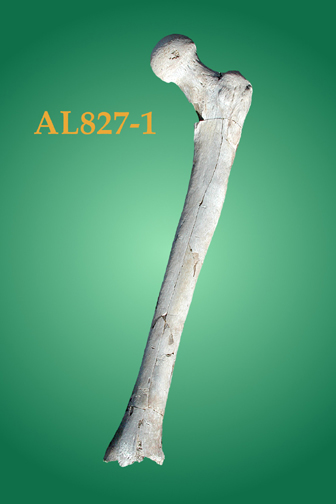
Hadar Pictures

This site is kind of cool! It contains pictures of Hadar (where Austalopithecus afarensis was discovered)! Below is an example.


It is AL827-1, a (left) femur discovered in 2000.

Read more!

Chimpanzees and Language

The origins of human language has always been a controversial subject. Witness the cranky exchanges after Lieberman claimed neandethals were not capable of language. The ability of apes to use language is even more controversial. Whether one is discussing the Gardner's attempts to teach a chimp english, or attempts to teach chimps and gorillas sign language, there is always a large amount of skepticism. The following research will probably generate a large amount of skepticism as well.

According to National Geographic News researchers at the University of St. Andrews in Scotland have discovered that chimps use certain distinctive grunts to communicate about food:

At the Edinburgh Zoo the chimps make high grunting noises when they find bread, a food they seem to like, and low grunting sounds when they find apples, which they apparently don't care for very much, according to the study, published last week in the journal Current Biology.

After noting the different types of grunts, the researchers set out to see if other chimps listening to the grunts interpreted them the way the researchers had ("bread" and "apple"). The researchers found that the listening chimp did seem to understand what the grunts mean.

The scientists recorded the grunts and played them to a chimp in the pen. When the chimp heard the "bread" grunt, the ape looked in the place in the pen where bread is usually found. When the "apple" call was played, the chimp searched appropriately for an apple.

"It shows that, by simply listening to each other's calls, chimpanzees can infer what kind of food the caller has found," said researcher Katie Slocombe, who worked with colleague Klaus Zuberbuhler on the project.


The researchers argue that these calls are referential signals but caution that:

"We don't know yet how specific these calls are—i.e., whether they specifically refer to bread or apples or whether they simply label highly preferred food [such as bread] and less preferred food types [such as apples]. We are planning further experiments to test these two possibilities," Slocombe said.


Over and above the issue of language, there may be another social function to these grunts:

Study co-author Zuberbuhler believes that the grunts serve a social function, since the chimps hardly ever make the noises when they are eating alone.

The grunts may be a call to dinner, Zuberbuhler says. "Chimps may find it genuinely unpleasant to eat without others doing the same."


*snip*

The possible dinner-bell grunts may be related to certain human vocalizations, Zuberbuhler said.

"We don't like to eat in the presence of others who are not eating," he said.

"In many cultures humans coordinate the timing of starting a meal, for example, with vocal cues such as 'bon appetit.'"


I, for one, can't wait to see the results of the planned follow up research.

Read more!

Saturday, October 22, 2005

New Stone Age Site found in the Sahara

According to National Geographic News:

The seven nearby sites include an extensive cemetery and represent one of the largest and best preserved concentrations of ancient skeletons and artifacts ever found in the region, researchers say.


Some back ground from the expedition website:

"...the desert has waxed and waned since the last Ice Sge to eventually become the expanding desert we know today."

As the lakes evaporated and disappeared 6,000 years ago, the people that had based their livelihood on its aquatic life, the Kiffians, were replaced by the first pastoralists of the Sahara, the Tenereans. This next group of people tended herds of just-domesticated African cattle on the grasslands between the encroaching dunes. These cattle herders, the Tenereans, lived from about 5,500 to 3,500 years ago. Our site contains their tools and ceramics, including beautifully made green stone disk-shaped axes. All of these transitions were happening before the first pyramid in Egypt was ever constructed.


Again from National Geographic:

The site may not have been continuously occupied. But it was likely inhabited for much of that time, which was a crucial one in early human history.

During the New Stone Age, humans moved from hunter/gatherer societies to become early agrarians who domesticated plants and animals.


*snip*

Tools such as large pottery and heavy grinding stones suggest that Kiffian peoples may have occupied the ancient lakeside area at least semi-permanently, Garcea says.

Scientists know that by about 6,300 years ago the Sahara's first pastoral people, the Tenereans, began tending herds of newly domesticated cattle.

And while the expedition team found remains of domestic cows and asses, researchers are uncertain whether Tenerean peoples occupied the particular dig site.


*snip*

The team says the site's human remains were most striking. Members found hundreds of skeletons in the site's large cemetery, some still adorned with ancient jewelry.

The researchers found tools, such as precision stone blades, bone hooks, pottery stamps, and other artifacts, in graves and other site locations.

Some artifacts suggest travel and perhaps even distant trade. Stone tools made of pale green volcanic rock could have their source some 50 miles (80 kilometers) distant in the Air Mountains, an area rich with period rock art.


Unfortunately, the site has attracted looters:

But archaeologists are not the only ones who have visited the historic site. Niger is a poor nation, and the temptation to profit from its rich cultural history has proven too great for some.

"We followed some 4x4 tracks that our guides said were definitely not made by tourists but by vendors going out there for stolen artifacts," Sereno said. "A photographer with our team estimates that he photographed as many as 3,000 artifacts in one day, found in shops of communities near the site."


Worse yet, because the site is in the desert it suffers from deflation, or erosion caused by the wind, and is changing rapidly:

"The wind is destroying these sites very quickly," Garcea, the Italian archaeologist, said. "I saw pictures that [Sereno] took in 2003, and you can really see the deflation."

"Some skeletons that were covered are now exposed to the surface and the hyper-arid desert conditions. In two or three years I'm sure I won't be able to see some of the things that we can study now," she added.

Read more!

New Digs at Teotihuacan


From National Geographic News:

The size of Shakespeare's London, Teotihuacán was built by an unknown people almost 2,000 years ago. The site sits about 25 miles (40 kilometers) north of present-day Mexico City. Temples, palaces, and some of the largest pyramids on Earth line its ancient main street.

Scientists believe Teotihuacán was the hub of trade and commerce in Mesoamerica until the city's civilization collapsed around A.D. 650. When the Aztecs stumbled upon the metropolis centuries later, they dubbed it the "City of the Gods," because they believed it was where the Gods met to create the present universe and sun.


Research has focussed on the Pyramid of the Moon (pictured above):

Excavations also reveal that the pyramid was constructed in seven stages, each stage an enlargement of the last. The work started in A.D. 100 and ended around A.D. 400.


Japanese researchers are searching for the tomb of the ruler who ordered the pyramids construction. It has not found it yet but:

Sugiyama has made some intriguing finds, including dozens of beheaded people with bound hands. The bodies suggest bloody sacrificial rituals ripe with symbolism of military power, he said.


Analyses by Spence of the University of Western Ontario suggest the sacrificed victims came from outside Teotihuacán, possibly as captives brought back from distant territories or battles.

The clues come from oxygen isotopes in bones, which act as geological markers. "They tell you where a person was at a particular time," he said.

Climate and altitude are among factors that affect the isotopes. The isotopes found in remains of pyramid victims differ from those unearthed in city homes.


Researchers also examined the teeth of the victems looking at the growth lines or perikymata:

"Basically growth stops as the body concentrates on survival and repair," he said. "Then as the stress passes, the growth continues again. But there's a line left in the tooth that represents the stress episode."

Because teeth only grow during childhood, scientists can put a general age to when the stress happened. These signatures of bodily stress remain in adult teeth.

"We have shown that in the last century of the city there is a growing problem of some sort. We get more and more indications showing up in adult teeth," he said.


There are two competing hypothesis for the destruction of Teotihuacan. One is that the city was destroyed by invaders from the outside. The other is:

Spence, however, says the evidence suggests to him the fires were set during an internal revolt.

According to his theory, the deteriorating health of the city's poor was likely exacerbated by a drought or a disruption to the food supply. This spurred a revolution against the ruling elite and their symbols of power—temples, pyramids, and palaces.

"The destruction seems to have skipped the vast majority of the city and focused on the elite and punished the elite. That suggests a revolt to me," he said.

Read more!

Friday, October 21, 2005

Paleoanthropology in Chad


The above is a picture of Sahelanthropus tchadensis, the seven million year old fossil from Chad. Recently a new paleoanthropology department (the first)was opened in Chad. According to BBC News:

The new palaeontology department will have space for 46 students, as well as a hi-tech laboratory to analyse fossils.

The head of the new unit, Dr Mackaye Hassane Taisso, set out his ambitions for the future.

"Listen, Toumaï is seven million years old, so our ambition is to find something older," he told the BBC.

"If we find a fossil about 10 million years old, that would be great. We are placing the bar very high, but we need to."

Read more!

Friday Stephanoidea (Wasp) Blogging


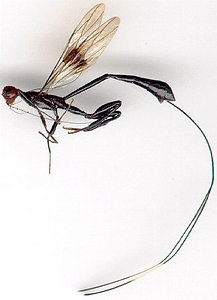
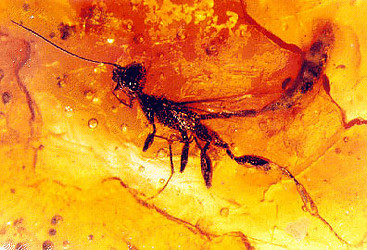
Above is a species of wasp called Megischus maculipennis. M. maculipennis belongs to the superfamily Stephanoidea - which are considered to be an ancient group of parasitic wasp. Today there are 323 living species in 11 genera. there are also 3 genera known from baltic amber.


They seem to be ectoparasites on wood boring insect larvae but are characterized by low host specificity. One intersting fact about Stephanoidea is that they seem to be characterized by high degrees of endemism. From The Tree of Life:

Stephanids live mostly in tropical forests, but many inhabit desert or semidesert areas ..., reach high latitudes (e.g., Megischus bicolor in Canada, Stephanus serrator in Germany, Hemistephanus artiosulcatus in Argentina), or are endemic in many oceanic islands throughout the world. The genera are normally restricted to one or two particular zoogeographical regions, such as Hemistephanus (Neotropical), Parastephanellus (Oriental and Australian), and Foenatopus (mostly Oriental and Afrotropical). No stephanid species, except for one introduced taxon, has been found in more than one zoogeographic region, suggesting a considerable degree of endemism ... There are no species of stephanids known from Chile.


Adults seem to be predominantly diurnal, but some species are attracted to light traps ..., suggesting that flight activity may start in, or extend to crepuscular hours. Flight and other movements are usually slow and weak, but cryptic coloration and behavior contribute to make many species inconspicuous in their habitat.

Read more!